Learn & Discover
Latest News from CollisionHub
EPISODE 6
THE AI
CRUTCH
WHEN THE TOOL STARTS TRAINING THE WORKER.
WITH KRISTEN FELDER
What happens when AI gets the answer right so often that we slowly lose the ability to recognize when it’s wrong?
This isn’t a hypothetical question. Another industry has already lived through it.
Aviation.
In 2013, an expert panel commissioned by the FAA raised concerns about something troubling. Highly trained, experienced commercial airline pilots were becoming overly dependent on automation, and some of their fundamental manual flying skills were deteriorating.
The technology wasn’t necessarily failing. In fact, its reliability was part of the problem.
Pilots were spending less time actually flying the aircraft manually. And when automation encountered a situation it couldn’t handle, control returned to a human who might not have exercised those critical skills in quite some time.
Think about that.
The technology worked so well that the people responsible for stepping in when it didn’t were becoming less prepared to do so.
Now consider what we’re doing in collision repair, insurance claims, estimating, and business operations.
We’re introducing AI systems that summarize information, interpret documents, recommend decisions, write estimates, and increasingly perform work that once required a human to evaluate evidence and exercise professional judgment.
We celebrate the time saved. We measure productivity gains. We talk about efficiency.
But who’s measuring what happens to the skills we no longer practice?
In my book, The Judgment Gap: What Collision and Claims Are Quietly Losing as AI Takes Over the Answers, I examine what I believe is one of the most overlooked risks of our industry’s rapid adoption of artificial intelligence.
It’s not simply whether AI can produce an accurate answer.
It’s what happens to the human who becomes increasingly dependent on receiving that answer.
Research into cognitive offloading, automation bias, and human attention reveals some uncomfortable realities.
Experienced professionals aren’t immune. Years of knowledge don’t necessarily protect a skill that is no longer being exercised.
And humans are particularly poor at performing one task that many companies are now assigning them: passively monitoring a highly reliable automated system for the occasional mistake.
The more reliable the technology becomes, the easier it is to stop questioning it.
That’s a serious consideration when the decisions involve vehicle safety, insurance coverage, repair methodology, financial outcomes, and potential liability.
Let me be clear. This isn’t an argument against AI. I use AI, and I see its enormous potential.
But there’s a difference between using technology to strengthen human judgment and designing an operation where technology gradually replaces the need to exercise it.
And that difference is a leadership decision.
In Episode 6 of The Judgment Gap Podcast — “The AI Crutch and the Human: When the Tool Starts Training the Worker” — I explore what aviation learned about automation dependency, what decades of human-factors research tell us, and why collision repair and insurance claims leaders should be paying attention.
Because the real test of your AI strategy may not be how efficiently your team performs when the technology works.
It may be what your people are still capable of doing when it doesn’t.
The podcast is a companion series to my book, The Judgment Gap, available on Amazon.
I’d encourage every shop owner, claims executive, manager, trainer, and industry leader to consider one question:
What work have you already handed to technology that your employees may no longer know how to do without it?
Answers are cheap. Judgment is the thing you cannot afford to lose.
BODY SHOP BOOK CLUB / EDITION #1
10 Lessons for Body Shop Owners
What The Subtle Art of Not Giving a F*ck can teach collision repair leaders about priorities, judgment, and building a stronger business.
EDITION #1
The business you build depends on what you choose to care about.
Collision repair owners are pulled in competing directions every day.
Insurers want predictable costs and speed. Customers expect quality and certainty. Employees need support. Vendors need payment. Industry programs introduce still more measurements and requirements.
The temptation is to treat every outside demand as a priority.
But satisfying everyone is not a business strategy.
It is possible to stay busy, grow sales, maintain strong insurer relationships, and still build a company that lacks profit, resilience, or independent decision-making. The more useful question is not whether the shop can meet every expectation, but which expectations deserve to govern the business.
This brief is not a chapter-by-chapter synopsis or a collection of quotations. It applies the book’s broad themes — values, responsibility, uncertainty, failure, and boundaries — to decisions collision repair owners face. The judgments about insurers, estimating, shop operations, and business models are industry commentary, not claims made by the book’s author.
PART ONE / RECLAIMING YOUR PRIORITIES
Who is really running your business?
01 Stop trying to make everyone happy.
The idea: Being liked by everyone is neither realistic nor a sound way to choose priorities.
In the body shop: Customers, employees, insurers, and suppliers have different interests. When the goal becomes pleasing all of them, the shop may quietly trade away price discipline, repair judgment, and control of its own process. Being professional does not require agreement with every demand.
EXECUTIVE QUESTION
Where are we saying yes simply to avoid an uncomfortable conversation?
02 Choose problems worth having.
The idea: A meaningful life does not eliminate difficulty; it involves choosing worthwhile challenges.
In the body shop: There is no friction-free shop model. Independent pricing and consumer education bring their own difficult conversations. High-volume insurer relationships can bring volume, administrative demands, and margin pressures. Evaluate the challenges you are willing and financially able to manage, not a promise that one model eliminates them.
EXECUTIVE QUESTION
Which problems are part of the business we intentionally chose — and which ones did we inherit without deciding?
03 Own the response, even when you did not cause the problem.
The idea: Responsibility for a response is different from blame for an event.
In the body shop: An insurer may dispute an operation, a part may arrive late, or a customer may misunderstand the process. None of that excuses weak estimating, poor documentation, unclear authorization, or inconsistent communication. Your response is where leadership and process maturity show up.
LEADERSHIP QUESTION
What recurring external frustration could we address through a better internal process?
04 Reject someone else’s scoreboard.
The idea: The values used to measure success shape behavior.
In the body shop: Car count, sales, cycle time, CSI, DRP rankings, and expansion can be useful indicators. None alone measures owner return, cash flow, quality, capability, or customer trust. A $10 million shop can be less financially healthy than a much smaller one. Measurement without context is a dangerous management habit.
LEADERSHIP QUESTION
If insurer volume disappeared tomorrow, which numbers would prove this was a healthy business?
PART TWO / THE DISCIPLINE OF JUDGMENT
Boundaries, certainty, and learning
05 Learn to say no.
The idea: Every commitment is also a rejection of other priorities.
In the body shop: Not every job, discount, program requirement, or proposed repair condition is right for your shop. Refusing work under terms that cannot support an appropriate repair and sustainable business is sometimes more responsible than accepting it. A useful “no” is backed by clear standards and a professional explanation.
LEADERSHIP QUESTION
What are our non-negotiables — and do our people know them before a conflict arises?
06 The most dangerous words in your shop might be “I know.”
The idea: Certainty can block curiosity; a willingness to question beliefs makes improvement possible.
In the body shop: “We’ve always done it that way.” “CCC says that’s the time.” “The insurer won’t pay.” “The procedure doesn’t say to.” “We’re certified.” Each can shut down investigation. With AI estimates and automated procedure research, it is even easier to confuse a fluent answer with an understood one. A shop can possess the correct OEM document without understanding why it applies, how operations connect, or what the repair demands.
LEADERSHIP QUESTION
Can the person making the decision explain the why and how — not merely show the document or software result?
07 Turn mistakes into organizational knowledge.
The idea: Failure can be part of learning, provided it changes future behavior.
In the body shop: An omitted operation, unpaid supplement, rework incident, or low-margin job creates useful evidence only when the team studies its cause. If the same failure recurs without changes to training, verification, or workflow, it is not a learning system; it is a repetition system.
LEADERSHIP QUESTION
What did our last five avoidable mistakes change about the way we work?
PART THREE / BUILDING SOMETHING THAT LASTS
Operate for substance, not appearances
08 Stop assuming your shop is the exception.
The idea: Feeling exceptional can obscure ordinary limits and blind spots.
In the body shop: Equipment, certifications, training subscriptions, and access to OEM information matter. They do not automatically deliver sound decisions, competent supervision, accurate job costing, or profitability. Repair expertise and business management are related skills, not interchangeable ones.
LEADERSHIP QUESTION
Which weakness have we overlooked because we take pride in our technical credentials?
09 Fight the battles that matter.
The idea: Attention is finite; using it well requires prioritization.
In the body shop: A disputed $20 operation may matter as a principle or as part of a repeated pattern. But spending hours on isolated arguments while ignoring labor-cost accuracy, technician productivity, or cash conversion can be poor resource allocation. Evaluate both the importance of a dispute and its opportunity cost.
LEADERSHIP QUESTION
What argument consumes the most energy while producing the least improvement?
10 Build a business that outlasts your presence.
The idea: A finite amount of time makes enduring values and commitments important.
In the body shop: A strong shop develops employees who can explain decisions, systems that protect customers, financial practices that support independence, and a culture that survives the owner’s absence. If every hard call requires the owner, the shop may have a capable individual rather than a capable organization.
LEADERSHIP QUESTION
If I left for 30 days, what decisions would stall — and why?
THE OWNER’S TAKEAWAY
An executive action agenda
A worthwhile book should do more than generate agreement. It should expose a decision that needs to change. Use the questions above in a leadership meeting and identify one measurable adjustment you can make within the next 30 days.
01 Define the scoreboard.
Identify five measures that genuinely represent financial health, repair capability, customer outcomes, and organizational resilience.
02 Write down your boundaries.
Document the repair, pricing, authorization, and process conditions your shop will not compromise without a deliberate leadership decision.
03 Audit one assumption.
Choose a frequently repeated belief about estimating, payment, OEM procedures, or insurer requirements. Find out whether your people can explain and defend it.
04 Close the learning loop.
Review three recent failures or rework events. Assign a process correction, owner, and follow-up date.
05 Develop judgment, not just compliance.
Ask team members to explain why an operation is required, how they verified it, and how it affects the complete repair.
The closing challenge
If your entire business model depends on keeping other people happy, whose business are you really building? The point is not to disregard customers, insurers, employees, or partners. It is to have the judgment to decide when their expectations align with your responsibilities — and when they do not. Better business decisions begin when the owner chooses what matters, knows why it matters, and builds a team capable of acting on that judgment.
ABOUT THIS EDITION
Body Shop Book Club takes selected ideas from widely read books and examines what they can teach collision repair business owners. Edition #1 draws inspiration from The Subtle Art of Not Giving a F*ck by Mark Manson.
This is independent commentary and is not affiliated with or endorsed by the author or publisher.
COLLISION HUB / COLLISION COFFEE TALK
Informed Repair Consent In Auto Claims and Collision Repair: Disclosing What Won't Be Done
A repair authorization tells a shop what it may do. What happens when a material manufacturer procedure is left out of the plan—and the vehicle owner never knows?
Collision Hub • Analysis & Commentary

COLLISION COFFEE TALK
THE LAW
COLLISION REPAIR
IS MISSING
INFORMED REPAIR CONSENT
For most of automotive history, consumer repair laws have concentrated on three basic questions: What work did the customer authorize? What work did the repair facility perform? What did the customer pay for?
Those remain important consumer protections, but they are no longer sufficient for the complexity of modern collision repair.
The traditional disclosure model was built around things: parts installed, parts removed, labor performed and dollars charged. Modern collision repair increasingly depends on processes: research, inspection, measurement, calibration, programming, joining methodology, corrosion protection and post-repair validation. A missing part is usually apparent. A missing calibration does not leave an empty hole in the dashboard, and omitted corrosion protection may disappear permanently inside a closed cavity.
As a result, two repair facilities can replace the same bumper cover, headlamp or structural component and still perform materially different repairs. One facility may research and follow the applicable manufacturer procedures. Another may omit some of them. To the vehicle owner, however, both repair plans may appear substantially similar because the differences often cannot be identified simply by looking at the parts listed on an estimate or invoice.
That exposes a significant weakness in the way automotive repair consent has developed. The existing system is generally designed to document what was authorized, what was performed and what was charged. It is far less effective at informing a consumer about material repair procedures that should have been considered but will not be performed.
That difference is increasingly important, and there is an established consumer-protection concept that can help address it: informed consent.
Authorization and Informed Consent Are Not the Same Thing
Automotive repair law already recognizes the importance of authorization. States commonly regulate estimates, work authorizations, additional repairs and final invoices. California, for example, requires an automotive repairer to provide a written estimate and obtain authorization before performing repairs, and to obtain further authorization when additional work is discovered (Cal. Bus. & Prof. Code §9884.9). The final invoice documents services and repairs performed and parts supplied (§9884.8).
Florida’s Motor Vehicle Repair Act (Fla. Stat. §559.901 et seq.) establishes similar requirements involving estimates and final invoices, while New York repair-shop regulations under Vehicle and Traffic Law Article 12-A address authorization, labor performed and parts supplied. Although the specific requirements vary among states, the underlying model is familiar throughout automotive repair: tell the customer what work is proposed, obtain permission to perform it and document what was ultimately done.
Many states already require something closer to variance disclosure. A majority of states require that an estimate identify when non-OEM, or aftermarket, crash parts will be used. That requirement rests on the same principle this article extends: when a repair departs from what the manufacturer specifies, the vehicle owner is entitled to know.
Those requirements provide real consumer protection, but authorization and informed consent are different concepts.
Authorization asks whether the customer agreed to the proposed work. Informed consent asks whether the customer received sufficient material information to understand the decision being made.
Medicine has long recognized this distinction. Informed consent is not simply the collection of a signature. It is a communication process through which a patient receives information about a recommended intervention, its expected benefits and burdens, reasonable alternatives and the consequences of declining treatment so that the patient can make an informed decision.
American law has also settled whose perspective defines what must be disclosed. In Canterbury v. Spence, the U.S. Court of Appeals for the D.C. Circuit held that materiality is measured by what a reasonable patient would consider significant to the decision, not by what physicians customarily choose to disclose.
Collision repair is not medicine, but the two share an important characteristic: a significant knowledge imbalance between the professional and the consumer.
A vehicle owner generally cannot independently determine whether a damaged structural component may be straightened, whether sectioning is permitted at a particular location, whether a component is one-time-use, whether corrosion protection must be restored or whether a camera or radar system requires calibration.
The fact that the consumer does not possess that technical expertise should not remove the consumer from the decision.
It is precisely why disclosure is necessary.
Informed Consent Must Begin With a Duty to Know
A workable Informed Repair Consent law cannot simply require a repairer to disclose manufacturer procedures it happens to know about.
That would create an obvious loophole. If Shop A researches the vehicle manufacturer’s repair information, identifies applicable procedures and becomes obligated to disclose any material deviation, while Shop B conducts no research and therefore claims to have nothing to disclose, the law would unintentionally reward ignorance and place the more diligent repairer at a competitive disadvantage.
For informed consent to have meaning, the legal framework must therefore require a collision repair facility, before finalizing a repair plan involving specified categories of collision damage, to access and review applicable vehicle-manufacturer repair information reasonably necessary to develop that plan.
At a minimum, that duty should apply when the repair involves structural components, occupant-restraint systems, ADAS components or sensors, high-voltage systems, repair-versus-replace limitations, joining or sectioning procedures, one-time-use components, required measurements or inspections, corrosion protection, calibrations, programming, or other systems that could materially affect the restored condition or safety performance of the vehicle.
The requirement would not mean that every technician must read every page of a manufacturer’s service information for every repair. The duty should be proportional to the damage and work being performed. A shop replacing a minor cosmetic component should not be required to research the vehicle’s complete structural repair manual.
The obligation should instead be framed around applicable repair information: information a reasonably competent repair facility should review in order to develop the repair plan for the damaged areas, components and systems involved.
The law should not require impossible omniscience. It should require reasonable professional diligence.
Once that duty exists, ignorance can no longer become a compliance strategy.
The Disclosure Trigger Should Be a Material Repair Variance
Requiring research does not mean requiring repair facilities to overwhelm customers with hundreds of pages of OEM procedures, which would create documentation without creating understanding.
The purpose of Informed Repair Consent should be to identify material differences between applicable manufacturer repair information and the repair that is actually being proposed.
The appropriate trigger is therefore a material repair variance.
After researching the applicable manufacturer information, the repairer develops the repair plan. If the proposed repair materially omits, substitutes for or deviates from a manufacturer-specified procedure, limitation, inspection or repair methodology, the variance must be disclosed to the vehicle owner before the affected work is performed.
The concept can be reduced to three questions:
What does the manufacturer information provide?
What does the proposed repair plan provide?
Is there a material difference between the two?
If there is no material difference, no additional variance disclosure is necessary. If a material difference exists, the consumer should be informed.
For example, if manufacturer repair information requires calibration of a driver-assistance system following specified repairs and the final repair plan excludes the calibration, that is a material variance.
Defining a Material Variance
The definition of a material repair variance will determine whether the law protects consumers or merely creates paperwork.
A reasonable statutory definition could cover an omission, substitution or deviation involving the categories identified above, or any other procedure whose omission could materially affect the restored condition, functionality, safety systems or crash performance of the vehicle. Materiality should be judged as medicine has judged it since Canterbury: by what a reasonable vehicle owner would consider significant to the repair decision, not solely by the view of the repairer or the payer.
The definition of applicable manufacturer repair information deserves equal precision. Manufacturers publish both repair procedures and position statements, and insurers and repairers frequently disagree about how much weight position statements should carry. A statute should resolve that question expressly rather than leave it to each individual dispute. One workable approach would treat published procedures and position statements that specify a required procedure, inspection or limitation for the damaged vehicle as applicable information, and treat general recommendations as advisory. The statute should also address permissive language such as “may” or “should,” and repairs for which the manufacturer publishes no procedure at all, in which case no variance exists and ordinary authorization rules apply.
A consumer does have a legitimate interest in knowing that a manufacturer-specified calibration will not be performed, a required structural measurement is being omitted, or a component identified by the manufacturer as replacement-only is instead being repaired.
Disclosure Must Occur Before the Decision Is Irreversible
A variance disclosed for the first time on the final invoice is not informed consent. At that point, the customer may have no practical opportunity to reconsider the repair methodology, discuss payment with the insurer, seek another professional opinion or select another repair facility.
The disclosure should therefore occur after sufficient disassembly, diagnosis and research have been completed to establish the repair plan, but before the shop performs the work affected by the variance.
Informed Repair Consent fits into that existing workflow, and the same steps repeat when supplements are written:
WHEN DISCLOSURE HAPPENS
Estimate → Disassembly and blueprint → OEM research → Repair plan → Identify material variances → Consumer disclosure → Authorization → Repair
What the Consumer Should Receive
The disclosure itself should be standardized, concise and written in language an ordinary vehicle owner can understand.
A disclosure should identify the applicable manufacturer repair information with enough specificity that the source can be located later; explain in plain language what that information calls for; state what the proposed repair plan will do differently and why; briefly explain the practical significance of the procedure without exaggeration, speculation or scare language; and document the consumer’s decision.
For example:
EXAMPLE DISCLOSURE
Manufacturer information: The vehicle manufacturer specifies calibration of the forward-facing camera following the identified repair.
Proposed repair plan: The calibration is not included.
Reason for variance: Payment remains disputed.
Repair facility position: Calibration is recommended based on the applicable manufacturer procedure.
Consumer options: Authorize the procedure, request additional explanation, ask the insurer to review its payment position, seek another repair opinion, or decline the procedure and proceed with the repair as proposed.
That is far more useful than presenting the consumer with a final invoice from which the calibration has simply disappeared.
"Why Is This Not Being Performed?" May Be the Most Important Question
Today, very different decisions can produce the same final result. A repairer may decide a procedure is unnecessary. An insurer may decline to include the procedure in its payment determination. A customer may knowingly decline the procedure. Those events are not equivalent and should not create an identical repair record.
Consider a calibration identified in applicable manufacturer information. The repairer determines that the calibration should be performed, but the insurer declines to include it in its payment determination. If the consumer is never informed and the operation simply disappears from the final repair plan, the historical record shows only that the calibration was not performed. It does not show why.
An informed-consent record would preserve each position separately:
WHAT THE RECORD WOULD PRESERVE
Manufacturer information identified: Yes
Repair facility recommendation: Perform procedure
Included in insurer payment determination: No
Consumer informed: Yes
Consumer decision: Documented
The record also separates four questions that are too often compressed into a single estimate: What does the manufacturer information say? What does the repair professional recommend? What will the insurer pay? What does the vehicle owner authorize? Those questions may produce different answers, and the repair record should preserve those differences.
An Insurance Estimate Is Not the Same as a Repair Plan
An insurer estimate serves a claims-settlement function. A repair plan serves a repair function. The two interact, but they are not the same document and do not answer the same professional question.
An insurer’s determination that a procedure will not be included in its payment should not automatically be transformed into a technical conclusion that the procedure is unnecessary.
Similarly, a repair facility’s determination that a procedure should be performed does not by itself establish that an insurer is contractually obligated to pay for it.
Those are separate determinations. A transparent repair record should preserve that distinction.
A consumer cannot assign value to a procedure no one has disclosed is missing.
The Requirement Should Apply Equally Across Business Models
Informed Repair Consent should not depend on whether a facility participates in an insurer network, holds an OEM certification or operates as an independent, dealership, regional MSO or national MSO. The consumer-protection principle should be the same.
That uniformity matters because consumers frequently rely on indirect indicators of repair quality: an insurer recommendation, a dealer referral, online reviews, a lifetime warranty or participation in an OEM certification program. Those factors may be useful, but none tells the consumer precisely how a particular damaged vehicle will be repaired.
Three Necessary Safeguards
A workable informed-consent law needs three safeguards for repairers and consumers alike.
First, disclosure cannot mean that a vehicle owner may compel a repair facility to perform work the repairer believes is unsafe, unlawful, inconsistent with licensing requirements or contrary to its professional judgment. The consumer may authorize the procedure, resolve the payment dispute, seek another opinion or move the vehicle to another facility, but the shop retains the right to refuse work it is unwilling to perform.
Consumer autonomy does not eliminate professional judgment.
Second, the disclosure form must not become a blanket release of liability.
A customer acknowledgment should document that information was provided and that a decision was made. It should not automatically waive statutory consumer protections, duties imposed by law, claims involving fraud or misrepresentation, or liability for work actually performed negligently.
The same principle should apply to insurance claim decisions. A customer’s signature acknowledging that a disputed procedure will not be performed should not automatically convert an insurer’s payment determination into a waiver of rights under the insurance policy or applicable claims law.
Third, repair facilities need assurance that complying with the disclosure requirement will not itself be treated as an admission of negligence.
A properly drafted statute should provide a limited safe harbor for accurate, good-faith disclosure. A repairer that correctly identifies applicable manufacturer information, fairly describes the variance and documents the consumer’s decision should not incur additional liability merely because it disclosed the issue.
The protection should apply to the communication itself, not to negligent repair. That distinction encourages transparency while preserving accountability.
Documented, good-faith disclosure is also in repairers’ own interest. Omitted manufacturer procedures already carry serious liability exposure, as the 2022 Texas jury verdict of more than $30 million in Seebachan v. John Eagle Collision Center illustrated.
The Law Should Require Disclosure, Not Agreement
The purpose of disclosure is not to eliminate disagreement.
It is to prevent disagreement from disappearing from the record.
Anticipating the Objections
Three objections deserve direct answers.
Disclosures could be used as leverage. Insurers may worry that repairers will use variance disclosures to alarm customers into pressing for payment. Standardized, plain-language disclosure content, a prohibition on speculative or exaggerated safety claims and regulator enforcement against misleading disclosures would limit that risk. The same record would also expose a repairer that overstates a variance.
The duty to research has a cost. Access to manufacturer repair information requires subscriptions, time and training, and that burden falls hardest on smaller facilities. Proportionality helps, because the duty would apply only to the damaged areas and specified systems. Legislators could also phase in the requirement. The alternative, however, is a market in which the facilities that already bear that cost are the ones that appear overpriced.
Materiality invites disagreement. Different facilities may reach different conclusions about whether a variance is material. A reasonable-owner standard, a statutory list of covered categories and model disclosure forms would narrow that discretion, and the responsible agency could issue guidance as disputed categories emerge.
Existing Estimating Technology Can Support the Process
Modern estimating and repair-planning platforms could support this as another structured layer, linking each applicable manufacturer procedure to the repair plan with a status such as included, not applicable, payment disputed, customer declined or alternative methodology proposed. Only material exceptions would need to populate the consumer disclosure.
The Final Invoice Should Reconcile What Was Not Performed
At vehicle delivery, the final documentation should reconcile material variances identified during the repair process.
The consumer would then leave with two complementary records: the traditional invoice documenting what was performed, and the Informed Repair Consent record documenting material procedures that were identified but ultimately not performed, along with the reason and the consumer’s decision.
Implementation and Enforcement
States would not necessarily have to rewrite their motor vehicle repair statutes to implement this concept. Informed Repair Consent could be added to existing authorization and recordkeeping requirements through the provisions described above: definitions of applicable manufacturer repair information and material repair variance, a duty to research, a disclosure trigger, timing and content requirements, supplemental disclosure, final reconciliation, and anti-waiver and good-faith safe-harbor provisions.
Finally, enforcement could remain with the state agency already responsible for motor vehicle repair licensing, repair-facility regulation or consumer protection. Remedies could include corrective action, administrative penalties, recordkeeping requirements and licensing consequences for repeated or knowing violations.
Insurers May Need a Parallel Disclosure Obligation
When an insurer has been provided applicable manufacturer repair information but declines to include the procedure in its payment determination, transparency should apply to the payer as well. An insurer should not be required to concede coverage merely because a manufacturer procedure exists. Coverage and payment obligations remain governed by the policy and applicable law.
However, when a material manufacturer procedure has been presented and the insurer affirmatively declines to include it in the payment determination, the reason should be made clear.
A meaningful statement would be:
The insurer has been provided Manufacturer Procedure X. The current payment determination does not include Procedure X for the following stated reason: ________.
That does not mandate payment. It documents the decision.
The consumer can then distinguish between a technical repair recommendation and a claim-payment determination rather than assuming they are the same thing.
Making Quality Repair Visible
We disclose price, parts and work performed. What we frequently do not disclose is material work that will not be performed.
The vehicle owner—the person who ultimately drives the repaired vehicle and places passengers back inside it—may never know that two materially different repair plans existed.
It would establish something more fundamental: a professional duty to identify applicable repair information, disclose material deviations from that information and give the vehicle owner an opportunity to make a decision before those deviations become part of the completed repair.
Our existing repair laws are generally effective at answering one important question:
What did you do to my vehicle?
Modern collision repair increasingly requires another:
What materially should I know about what you are not going to do?
The difference between those questions is the difference between obtaining authorization and obtaining informed authorization.
None of this requires the industry to agree on every repair procedure, every payment dispute or every coverage question. It requires agreement on a narrower principle: the person who owns the vehicle, and who will place passengers back inside it, should learn of material departures from the manufacturer’s repair information before the repair is complete, not after, and not never. Repairers, insurers, regulators and consumer advocates each have a legitimate stake in how that principle is written into law.
The practical question for the industry is whether to help shape that framework now or respond later to one drafted by others.
COLLISION HUB / INDUSTRY PERSPECTIVE
When Experience Walks Out of Claims, What Happens to The Decisions?
When experienced people leave collision repair and claims, what happens to the decisions that depend on their judgment?
THE JUDGMENT GAP / EPISODE 3 / COLLISION REPAIR & INSURANCE CLAIMS
You can download information.
You can automate information.
You can build a knowledge base full of procedures, repair information, claim history, policy language, OEM requirements, photos, estimates, and data.
But at some point, someone still has to decide what all of it means.
That is where judgment enters the process.
And that is the problem I explore in Episode 3 of The Judgment Gap.
Across collision repair and insurance claims, experienced people are leaving. Some are retiring. Some are being laid off. Others are simply deciding they no longer want to work inside systems that increasingly measure productivity, speed, and compliance more heavily than experience.
When those people leave, companies often assume the loss can be solved with better training, more documentation, a larger knowledge base, or artificial intelligence.
Those tools can absolutely improve access to information.
They cannot automatically replace what an experienced person has learned from seeing hundreds or thousands of situations that did not fit neatly into the process.
A procedure can tell you what normally happens. Experience helps you recognize when this file is not normal.
That distinction matters.
An experienced estimator may recognize that a repair procedure does not match the damage in front of them.
An experienced technician may notice something that does not look right before the vehicle goes back together.
An experienced adjuster may realize that the facts in the file do not support the conclusion the system is suggesting.
An experienced manager may know that a seemingly minor issue is actually the beginning of a much larger problem.
Those decisions are difficult to capture in a manual because much of judgment is built through exposure.
You see a situation.
You make a decision.
HOW JUDGMENT GROWS
- You see the result.
- You learn.
- Then you carry that lesson into the next decision.
- Do that for 10, 20, or 30 years and you have something very different from simply possessing information.
- You have context.
That does not mean experience is always right. It does not mean technology or AI should be rejected. And it certainly does not mean younger employees cannot develop strong judgment.
It means we have to be much more deliberate about how judgment is transferred before experienced people leave.
Because if the industry’s answer to losing experienced employees is simply, “Don’t worry, we put everything in the system,” we may discover that we preserved the information while losing the ability to interpret it.
That is the difference between a knowledge problem and a judgment problem.
And I think a lot of organizations are trying to solve the second one with tools designed for the first.
In Episode 3 of The Judgment Gap, I dig into what experience actually contributes to decision-making, why conventional training cannot completely reproduce it, and what happens when organizations confuse access to answers with the ability to make good decisions.
Episode 3: “Experience Is Leaving: What Happens When Judgment Walks Out”
If you work in collision repair, insurance claims, training, management, or anywhere people are being asked to make increasingly complex decisions with fewer experienced people around them, this conversation is worth having.
NEW CLASS-ACTION SETTLEMENT
When Insurers Deduct Fees From a Total-Loss Settlement
Why the real question is where the money went
Fair Claims Stronger Consumers
Florida Class Action Settlement Returns Body Shop Total-Loss Fees Deducted From ACV Settlements
The settlement is a consumer win, but its larger significance may be the legal and economic question it exposes: what authority allows an insurer to shift a disputed claims expense into the policyholder’s property settlement, and who ultimately benefits when the insurer later monetizes the salvage?
A proposed Florida class-action settlement deserves attention well beyond the dollar amount involved.
In Maxim Kharevich v. Star Casualty Insurance Company, the plaintiff challenged, among other things, the insurer’s practice of deducting amounts it considered excessive storage and towing charges from insureds’ actual-cash-value payments on total-loss claims. Under the proposed settlement, qualifying consumers may recover certain storage and towing deductions previously applied against their ACV settlements.
Star Casualty denies wrongdoing, the court has not determined that the company violated the law, and the settlement remains subject to final approval.
The immediate significance is that money previously removed from consumers’ total-loss settlements may now be returned to those consumers. The more important contribution of the case may be the way attorney Andrew Irvin and the plaintiff’s lawyers framed the underlying problem. This was not fundamentally a dispute over whether a body shop charged too much for storage. It was about what happened to the insured’s money when the insurer disputed someone else’s invoice.
The repair facility is largely outside the contractual relationship at issue. It is not a party to the insurance contract, does not determine the insured’s policy benefits, does not receive the insured’s ACV payment, and generally does not participate in the insurer’s eventual salvage recovery. Its invoice may trigger the controversy, and its records may become important evidence, but the consequential financial transaction occurs between the insurer and its policyholder.
The Invoice Dispute and the Insurance Benefit Are Separate Transactions
Much of the collision industry has historically approached these disputes as questions about the reasonableness of the shop’s invoice. The insurer challenges a storage charge, the repairer defends its rate and authorization, and the discussion becomes a vendor-payment dispute.
Irvin’s framing separates that dispute from the insured’s contractual benefit. An insurer may have a legitimate disagreement with a repair facility over what it owes on an invoice. There may be lien statutes, storage laws, contractual arguments or other mechanisms available to resolve that disagreement. None of those issues, however, automatically establishes that the disputed amount may be removed from the money owed to the insurer’s own policyholder for the loss of the automobile.
That distinction changes the legal inquiry.
Rather than beginning with whether the shop’s storage charge was reasonable, the more important question is what policy provision, or legal authority permitted the insurer to resolve that dispute by reducing the insured’s property settlement. The plaintiff’s theory separated the shop invoice from the customer’s insurance benefit rather than treating the two obligations as interchangeable.
Consider a vehicle with a calculated ACV of $20,000. If the insurer disputes $1,000 in storage charges and deducts that amount from the property settlement, the insured receives $19,000. The repair facility may still have a billing dispute, but the policyholder has absorbed the immediate financial effect. The central issue is not simply whether the storage rate was excessive, but whether there was a contractual or statutory basis for shifting that expense into the insured’s settlement.

Why Small Deductions Can Produce Large Consequences
The amounts involved in an individual claim can make a case like this appear modest. The proposed settlement provides qualifying insureds with repayment of certain storage and towing deductions, subject to limits that include up to $25 per day for eight days, or $200, plus prejudgment interest for qualifying deductions.
Insurance claims operate at scale. A $200 reduction on one file is limited. The same methodology applied across hundreds or thousands of files produces a different financial effect. That is one reason class-action litigation often focuses on whether a common method or claims practice was repeatedly applied across a larger group of consumers.
The same concern becomes more significant as claims handling becomes more standardized and automated. A questionable judgment made manually may affect a single file. The same judgment embedded in a workflow can be repeated across thousands of claims. Standardization does not validate the underlying decision; it can simply magnify its consequences.
The settlement therefore carries significance beyond the repayment of relatively small deductions. It creates a concrete basis for examining every reduction from ACV as a separate decision that should have identifiable support in the policy, applicable law or another valid contractual obligation.
The Settlement Resolves One Issue, but Salvage Raises Another
My interest in this issue extends beyond the claims resolved by the Star Casualty settlement. Once the insured’s ACV payment is separated from the shop’s invoice, another financial transaction becomes visible: salvage.
A total-loss vehicle retains economic value even when repair is no longer economically justified. Unless the owner retains the salvage, the insurer generally takes possession of the damaged vehicle and monetizes the remaining asset through the salvage marketplace. Those proceeds become a recovery associated with the claim.
Using the same example, assume the insurer reduces the insured’s payment by $1,000 because of a disputed storage expense, leaving a $19,000 payment. The insurer then takes possession of the damaged vehicle and later sells the salvage for $6,000. The insurer has paid $19,000 and recovered $6,000 from the remaining property.
At that point, the analysis should extend beyond the reasonableness of the storage rate. The insured absorbed the disputed $1,000 expense. The insurer took possession of the asset, monetized it, and received the salvage recovery. That sequence raises a broader legal and economic question: whether an insurer that transfers an expense to its policyholder while retaining the economic benefit associated with the salvage has received a benefit at the insured’s expense.
The Unjust-Enrichment Question
The Florida settlement did not establish an unjust-enrichment claim, and the court has not ruled that this fact pattern constitutes unjust enrichment. I also have not identified a reported decision squarely addressing the precise sequence described here: a disputed storage or claims-related expense deducted from the insured’s ACV, followed by the insurer taking possession of the salvage, selling it, and retaining the resulting recovery.
That leaves an important area for legal analysis.
Unjust enrichment is not simply another label for an outcome that appears unfair. Its elements and availability vary by jurisdiction, and the existence of an express insurance contract can materially affect the analysis. Depending on the facts and applicable law, the more appropriate theory may involve breach of contract, an improper offset, restitution, unfair claims practices, unjust enrichment or another cause of action.
The economic transaction still deserves scrutiny. If the policyholder bears an expense associated with obtaining or disposing of the damaged asset while the insurer receives the full recovery from that asset, value has moved between the parties. The insured surrendered the vehicle and received less money because of the deduction. The insurer acquired an asset with residual value and used the proceeds from that asset to improve the net economics of the claim. Those facts do not establish unjust enrichment by themselves, but they provide a basis for examining whether the transfer was authorized and who ultimately benefited from it.
This is an area where total-loss litigation may be underdeveloped. Considerable attention has been paid to whether vehicles were properly valued. Less attention has been paid to what happens after the valuation is complete.
A Correct ACV Can Still Produce an Incorrect Settlement
Attorneys reviewing total-loss claims often begin with the valuation report, and appropriately so. Determining whether the valuation methodology produced a supportable ACV remains important. A valuation report and a settlement reconciliation, however, answer different questions.
The valuation report establishes what the automobile was worth. The settlement reconciliation explains what happened to the money after that value was established.
A vehicle can be correctly valued and the policyholder can still be underpaid if unsupported deductions are applied afterward. A complete analysis should therefore begin with the calculated ACV and then reconcile the deductible, taxes and fees, betterment or depreciation where legally permitted, towing, storage, administrative charges and every other offset that reduced the amount ultimately delivered to the insured. Each reduction should be traceable to a policy provision, statute or other legal authority.
The financial analysis may also need to continue beyond issuance of the settlement payment. Where relevant and legally obtainable, attorneys should examine possession, title, salvage disposition and recovery. If the insured’s payment was reduced because of an expense associated with the vehicle, understanding what happened when the insurer later monetized that vehicle may be necessary to reconstruct the full economics of the claim.
Collision repairers have a narrower role, but an important evidentiary one. Authorization records, storage dates, notices, insurer communications and vehicle-release documentation may help establish the sequence of events. The more useful inquiry is not simply whether the insurer paid the shop’s invoice, but what happened to the customer’s settlement because the insurer disputed that invoice.
Why I Wrote Total Loss Claim Handling
This case illustrates one of the central principles in Total Loss Claim Handling: File Process & SOPs: a total loss should not be treated as a single transaction.
ACV determination, the policy deductible, towing and storage, lien rights, title transfer, possession, salvage and the carrier’s recovery are separate legal and financial events occurring within the same claim. When those events are blended together, it becomes much harder to identify how money moved between the parties. Separating them changes the analysis.
That framework affects claim review, document preservation, discovery, appraisal analysis and expert work. It can also expose legal issues that remain hidden when every component of the claim is compressed into a single settlement event.
The handbook was written to help professionals examine the entire architecture of the total-loss file: what was owed, under what authority, when possession changed, where recoveries occurred, and how each transaction affected the insured.
A Consumer Win That Should Become a Foundation
The immediate result of the Florida settlement is significant. Consumers whose qualifying storage and towing deductions fall within the settlement terms may receive money back that had previously been deducted from their total-loss settlements. The identified class period runs from March 22, 2018 through June 26, 2026.
Its broader value may be the analytical foundation it provides. A disputed third-party expense should not simply appear as a reduction in an insured’s ACV payment without identifiable contractual or statutory authority. Once that issue is examined, the analysis should continue through the rest of the financial transaction, including possession of the damaged property and salvage recovery.
Future total-loss litigation may increasingly focus not only on whether the vehicle was undervalued, but on whether a correctly established value was later reduced through deductions that lacked proper support. That shifts the inquiry from valuation alone to settlement architecture.
For professionals who want to examine total-loss files at this transaction-by-transaction level, Total Loss Claim Handling: File Process & SOPs lays out the framework I use to separate valuation, settlement, possession, liens, storage, salvage and recovery rather than treating them as one financial event.
I also explore the Florida settlement and the broader unjust-enrichment question in the new members-only episode of Collision Coffee Talk.
The settlement may prove important not simply because money is being returned to consumers, but because it directs attention to a larger issue that deserves further legal development: whether every reduction from a total-loss settlement was authorized, and what happened to the economic benefit after the vehicle left the policyholder’s hands.
NEWS & ANALYSIS
Allstate Patented a Different Way to Pay Collision Claims - And the Industry Never Paid Attention
A patent, a Canadian claims model and a wave of litigation point toward a collision economy that may no longer depend on the traditional estimate.
THE CLAIMS MODEL HIDING IN PLAIN SIGHT
For most of the last forty years, collision repair has revolved around the same basic process: a vehicle is damaged, someone inspects it, an estimate is written, and the repairer and insurer work through the differences until a payment is reached.
Technology has changed how that process happens. Photo-based estimating replaced some field
inspections. DRPs changed how claims are routed. Supplements moved into electronic portals. Artificial
intelligence is beginning to automate portions of estimating and claims review.
But underneath all of those changes, the basic architecture remains remarkably familiar. We still inspect
damage, determine the expected cost of an individual repair, document that cost and negotiate
disagreements.
An enormous industry has been built around that architecture. Billion-dollar software companies, estimating
platforms, claims organizations, repair networks, adjusters and estimators are all developing increasingly
sophisticated versions of essentially the same mousetrap.
“What if the next version of the auto claim does not require an adjuster reviewing individual repair decisions — or a shop producing the traditional written estimate?”
More importantly, what if insurers have already spent years developing and discussing economic models
that could make much of that possible while almost no one in collision repair was paying attention?
That is where the newest episode of Collision Coffee Talk begins.
The Patent
Allstate has a patent family involving insurance claim capitation and predictive payment modeling for
vehicle repair claims. Its history traces back to 2012, when Allstate still owned Sterling Collision Centers.
The language is worth reading carefully because this is not another version of a DRP program. The patent
describes a model in which an insurance company could pay a repair facility a fixed predicted capitated
amount for each repair claim, regardless of the amount of repair work ultimately required.
That changes the underlying economic question.
The traditional model asks what this vehicle costs to repair. A predictive or capitated model can instead ask
what a population of repairs should cost and who is willing to manage the financial variance within that
population.
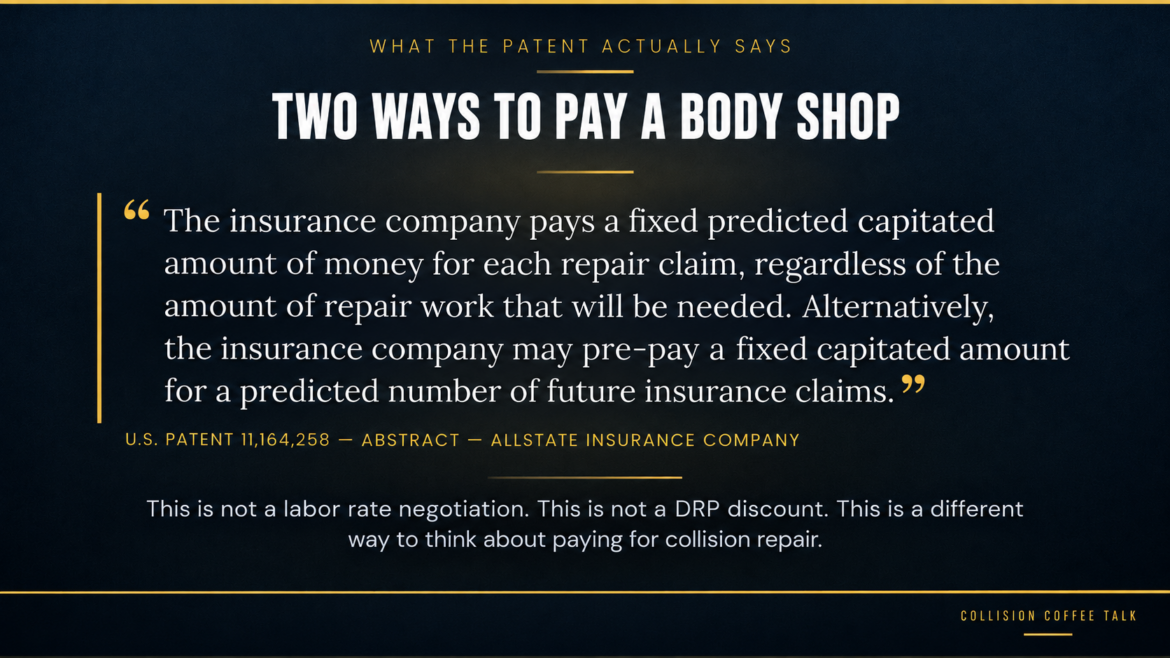
The patent describes fixed predicted payments for individual claims — and a pre-paid amount for a predicted number of future claims.
This is not a labor-rate negotiation. It is not a DRP discount. It is a different way to think about paying for collision repair
The Trail Goes Through Canada
Years before Allstate’s patent filings, ICBC was publicly discussing a different approach to repair-provider
economics in British Columbia. A 2004 legislative record documents questions about collision shops being
measured against average repair costs, with financial consequences tied to their performance. ICBC officials
described a broader performance model incorporating average repair cost, cycle time and customer
satisfaction.
Then, in 2015, the published agenda for the MSO Symposium in Detroit included a panel called Claims
Management Models. Representatives included ICBC, Ford Motor Company, Allstate and Assured
Performance Network. The advertised subjects included repair segmentation, certified repair centers, OE
certification, parts-purchasing models and capitation.
Representing Allstate on that panel was Clint Marlow. Marlow’s name also appears among the inventors
associated with Allstate’s capitation patent, along with Randy Hanson.
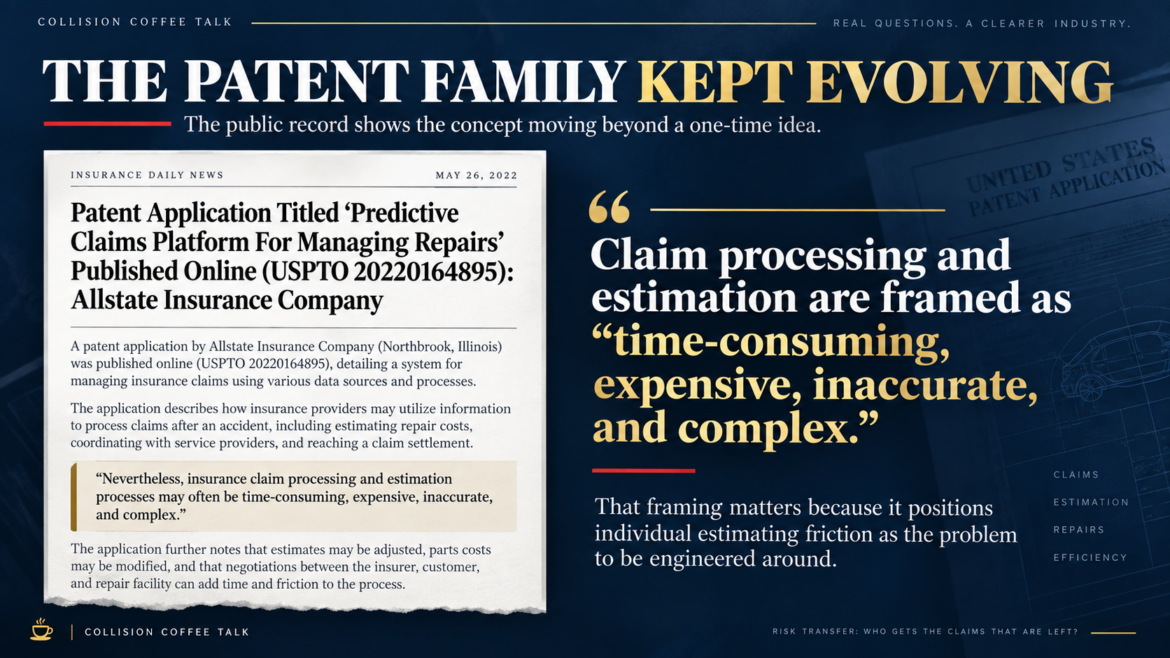
The patent family’s later language describes traditional claim processing and estimation as costly friction to be engineered around.
Now Look at the Explosion in Litigation
The history takes a current-events turn when viewed against the wave of litigation and regulatory disputes
involving claims-handling practices.
Cases and disputes in states including Oklahoma, Montana, Alabama, California, Illinois and Texas are
placing increased attention on insurer influence over claim decisions, repair-payment decisions, internal
standards, appraisal and the authority of the people handling losses.
Who makes the individual repair decision — and who carries the economic and legal risk associated with it?
Collision Repair Needs to Pay Attention to What Comes Next
The reason I believe this history matters now is that several economic pressures are converging at the same
time.
Insurers want more predictable repair economics. Large MSOs have unique financial pressures and need
utilization and claim volume. Vehicles are becoming more complicated to diagnose and repair. Individual
claim decisions are becoming more expensive to inspect, document, negotiate and supervise.
At the same time, litigation is placing greater scrutiny on how insurers influence those decisions, while the
overall pool of repairable claims is falling.
THE CONNECTION THAT MATTERS
The patent by itself is interesting. The Canadian history by itself is interesting. The litigation happening today is interesting. The shrinking repairable-claim pool is interesting.
The story is what happens when you put all of them together.
In the newest episode of Collision Coffee Talk, I walk through the documents, the history and the economics
behind where I believe this could be heading — and why the next great consolidation of collision repair may
have very little to do with one MSO buying another.
You need to hear this one.
Because the biggest disruption coming to collision repair may not be the next great estimating system.
It may be a claims model that no longer needs adjusters, traditional written shop estimates — or the
estimating software sitting between them.
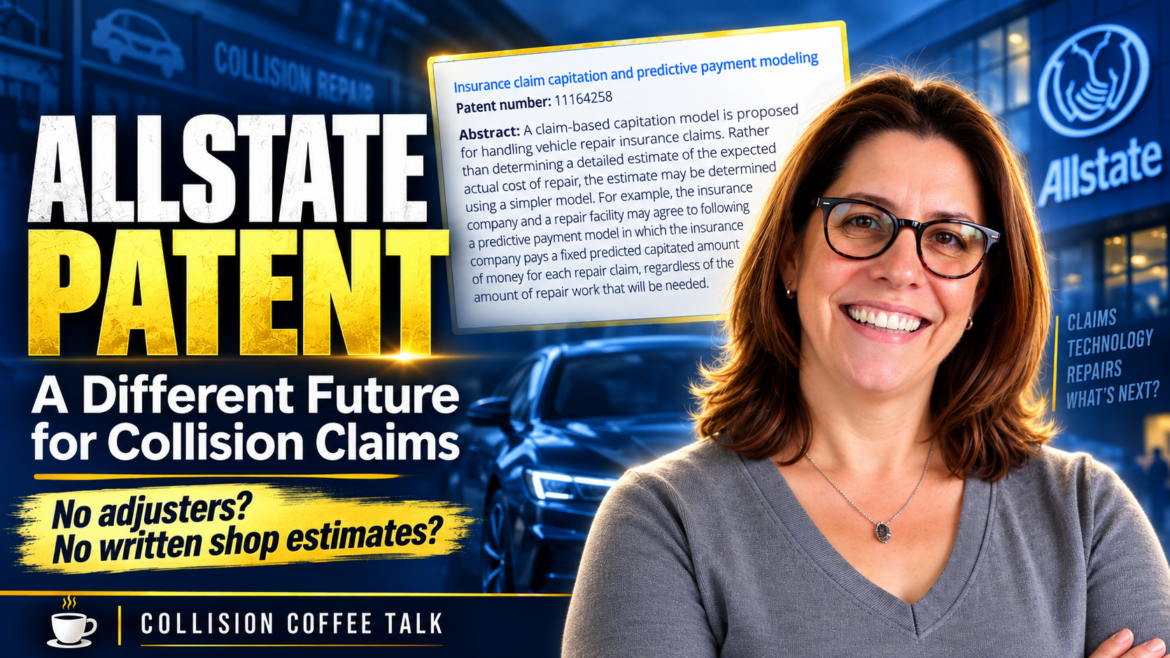
WATCH THE NEWEST EPISODE OF COLLISION COFFEE TALK
Follow the documents, the history and the economics behind a potentially different future for collision claims.
THE JUDGMENT GAP: EPISODE 2
Training Isn't the Problem. Confusing It Is.
Why more training does not always produce better performance.
ABOUT THIS EPISODE
More training should lead to better performance, right? But in collision repair and insurance claims, the reality is more complicated. In Episode 2 of The Judgment Gap, Kristen Felder explores why training alone does not create capability and how confusion, not a lack of training, is often the real issue.
Employees are not rejecting learning. They are telling us that the traditional training model is not meeting them at the moment where the work becomes difficult.
This episode looks at what gets in the way, how to bridge the gap between knowledge and application, and what collision professionals need to make confident, consistent decisions.
"Nobody wants to be trained anymore."
But that's not actually what is happening.
THE REAL QUESTIONS
It's not that people don't want training. They want clarity. They want to know:
What do I do with the file in front of me?
What applies to this vehicle?
What if the standard answer doesn't fit?
Who can help me decide right now?
TRAINING COMPLETION IS NOT CAPABILITY
Training is important. It builds awareness, introduces new concepts and creates a foundation. But completing a training module does not automatically mean someone can apply the information in a real repair scenario.
True capability shows up when people can take what they have learned, apply it to the unique details of a vehicle and make a sound decision. That takes more than a certificate. It takes context, experience and support.
In collision repair, the gap is not between people who are trained and people who are not. The gap is between what people know and what they are confident to apply when it counts.

"Training completion proves exposure. It does not prove capability."
AI MAKES THE JUDGMENT GAP MORE IMPORTANT
Artificial intelligence is changing how we work in collision repair. AI can analyze a vehicle, suggest repair procedures and surface relevant information in seconds. That speed and access are powerful, but they also highlight something important: tools do not make the decision, people do.
As AI becomes more common, the need for human judgment, critical thinking and real-world experience only grows. The technology can inform the process, but it cannot replace the professional who understands what applies, what does not and why.
- AI can surface information. You decide what is relevant.
- AI can suggest procedures. You apply them in context.
- AI can save time. You ensure accuracy.
- AI can identify possibilities. You weight the options.
- AI can support the process. You make the call.

A CONNECTED SYSTEM WORKS BEST
Training is just one part of the solution. A stronger, more capable workforce comes from a connected system.
Foudational Training
Reference Information
Workflow Support
Reference Information
Expert Guidance
AI
The workforce may not need another module.
They need more clarity, better support and a system that helps them apply what they know.
About The Judgment Gap
The Judgment Gap: What Collision and Claims Are Quietly Losing as AI Takes Over the Answers is written by Kristen Felder, founder of Collision Hub.
The book examines the intersection of artificial intelligence, collision repair, insurance claims, training, expertise and human decision-making.
Rather than arguing against technology, The Judgment Gap explores how organizations can use increasingly powerful AI and automation without allowing the human knowledge necessary to question, verify and correctly apply those answers to disappear.
About Kristen Felder
Kristen Felder is the founder of Collision Hub and has spent more than three decades working at the intersection of collision repair, automotive insurance claims, training and industry education.
Her experience includes collision repair operations, insurance claims handling, claims training and management, consulting, repair and claim analysis, and work involving complex disputes and litigation.
Through The Judgment Gap book and podcast series, Felder is asking collision repairers, insurance claims professionals, technology companies and industry leaders to reconsider a basic assumption that has shaped decades of technology and training investment:
Having the answer is not the same as having the judgment to use it.
NEWS & ANALYSIS
First Brands Goes Chapter 7. Why Collision Should be Paying Attention.
Debt, valuation and shrinking claim volume are reshaping the collision economy.
By Kristen Felder, Collision Hub
Is there a CCC. Group 1. Crash Champions Connection?
A few months ago, First Brands was already a warning sign. The company entered bankruptcy carrying billions in liabilities despite owning some of the most recognizable brands in the automotive aftermarket.
Now the story has moved into Chapter 7 liquidation, and the lesson is getting harder to ignore.
The issue is not simply that one automotive supplier failed. The more important question is what this says about debt, valuation, private credit, and the assumptions investors have made about the automotive economy.
First Brands reportedly entered bankruptcy with more than $9 billion in liabilities and very little cash. Attempts to restructure failed. Asset sales did not generate enough value. Creditors are now fighting over receivables, liens, collateral, and priority.
That matters because sophisticated lenders and investors believed there was enough value in the business to support enormous amounts of financing. They were wrong. And financial markets tend to remember expensive mistakes.
That does not mean First Brands is directly comparable to CCC, Crash Champions, or dealership collision operations. It is not. But those companies all exist inside the same capital market and the same broader collision ecosystem.
That is where the story gets interesting.
Dealer collision is sending a signal too
In a recent episode of Collision Coffee Talk, we discussed declining collision performance at major dealership groups, including Group 1 Automotive.
Group 1 has reported softer collision revenue and has closed or repurposed collision facilities where the returns no longer justified the space. That is an important data point.
It suggests that current weakness is not simply a private-equity or MSO management problem.
Different owners. Different capital structures. Same collision market.
If dealership collision centers, independent shops, and large MSOs are all dealing with pressure on repairable claim volume, then investors and lenders eventually have to ask whether this is cyclical or structural.
Consolidation cannot create claims
For years, the collision investment thesis was compelling. Buy shops. Build scale. Improve purchasing. Increase market share. Grow EBITDA. Refinance. Acquire more shops.
But there is one problem with that model:
Consolidation does not create another accident.
An MSO can gain market share, but it cannot manufacture repairable claims. If the overall repairable-claim pool is shrinking, a larger company may simply own a larger percentage of a smaller market.
That becomes critical when debt has to be refinanced.
THE COLLISION ECONOMY
Four forces shaping what comes next.
First Brands
A major supplier falls, raising questions about supply chain stability and asset valuation across the industry.
Group 1
Dealerships face margin pressure and evolving strategies, with collision no longer a guaranteed offset.
Crash Champions
A major supplier falls, raising questions about supply chain stability and asset valuation across the industry.
CCC
A major supplier falls, raising questions about supply chain stability and asset valuation across the industry.
Why Crash Champions matters
Crash Champions is one of the companies worth watching because significant debt maturities arrive later this decade. The issue is not whether that company is “failing.” The issue is how lenders will value and underwrite the business when refinancing discussions intensify.
They will not simply use the assumptions from the last financing. They will look at current EBITDA, free cash flow, margins, claim volume, same-store performance, market outlook, and collateral value.
In other words, refinancing becomes a new appraisal of the business. If the market has changed, the valuation can change with it.
CCC is a different company, but the same question applies
CCC is not financially distressed like First Brands. But reports that CCC has explored strategic alternatives and a potential sale raise another valuation question.
What is a claims-technology platform worth if repairable claim volume continues to weaken?
CCC can point to strong margins, network effects, data, insurer integration, and AI.
A buyer can ask a different set of questions:
How many claims will exist in the future?
What happens if insurers build more technology internally?
What happens if AI changes estimating and claims workflows?
What multiple should be paid for that future?
That is the common thread.
The bigger issue is not one company
First Brands, Group 1, Crash Champions, and CCC are very different businesses. But all four are giving investors information about the same underlying market.
First Brands shows what happens when debt and asset value separate. Group 1 shows what happens when collision space no longer produces an acceptable return. Crash Champions shows why future refinancing matters in a weaker operating environment. CCC shows how changing claims volume can affect valuation even in a profitable technology company.
The larger question is simple:
What if the financial models were built around a collision market that no longer exists?
That is the discussion in the latest 30-minute episode of Collision Coffee Talk.
We break down the First Brands Chapter 7 conversion, the creditor fight that comes next, dealer collision pressure, MSO refinancing risk, private-equity exit pressure, and what all of it may mean for the future value of collision businesses.
Watch the full episode for the complete analysis and the connections behind the headlines.