
The Power of Questioning in Automotive Physical Damage Claims
How a questioning-based front office builds trust, reduces friction, and keeps customers aligned when claims get hard.
Collision repair customers do not arrive in a neutral emotional state. Instead, they arrive after a disruptive loss event while managing transportation gaps, deductible exposure, insurer communication, scheduling pressure, and uncertainty about what the shop will find once repairs begin. A 2024 CCC study of 2,400 first-party claimants found that a transparent, detailed explanation of repair needs outweighed speed as the top driver of satisfaction. In addition, customers experience insurers and repairers as a single, intertwined journey, not separate encounters.
Most collision front offices define professionalism as rapid explanation: explain the damage, the estimate, the delay, the supplement, and what insurance will or will not cover. That instinct is well intentioned. However, it can make the shop sound like just another authority in a chain of authorities already issuing instructions — the carrier, the adjuster, the app, the rental timeline, and the policy. When that happens, insurer-induced friction does not stay with the insurer. It gets redirected at the shop.
Questioning is the alternative. Not questioning as small talk or stalling, but questioning as a frontline operating discipline. When customers are invited to speak, clarify, and participate early, trust rises, defensiveness falls, and the shop is better positioned to keep the customer aligned when claims get difficult.
1. Why telling often fails
Psychological reactance helps explain the pattern. When people feel their freedom or autonomy is constrained, they experience a motivational state that drives resistance. As a result, the more a message feels like control, the more likely it is to trigger pushback.
That dynamic plays out daily in collision repair. Customers already receive instructions from carriers, adjusters, apps, policy language, and rental deadlines. Therefore, a shop that responds with more instruction can unintentionally recreate the same loss of control the customer already associates with the claim. Questioning interrupts that pattern because it shifts the first move from control to invitation.
Self-determination research adds another layer. Autonomy, competence, and relatedness are fundamental psychological needs. In a claim and repair setting, questioning supports all three. It gives the customer a role in the conversation (autonomy), helps the shop address what the customer is genuinely trying to solve (competence), and demonstrates genuine attention and care (relatedness).
Many conflicts in collision repair are not purely technical disagreements. For example, a customer who keeps asking about timing may be experiencing a competence problem — “I cannot plan my week.” Likewise, a customer angry about an insurer delay may be experiencing an autonomy problem — “Decisions about my car are happening without me.” In addition, a customer who dreads incoming calls from the shop may be experiencing a relatedness problem — “Contact with this process means more pressure, not support.” A questioning model gives the shop a practical way to stabilize each of these needs.
2. What questioning does
- It builds responsiveness before the hard conversations.
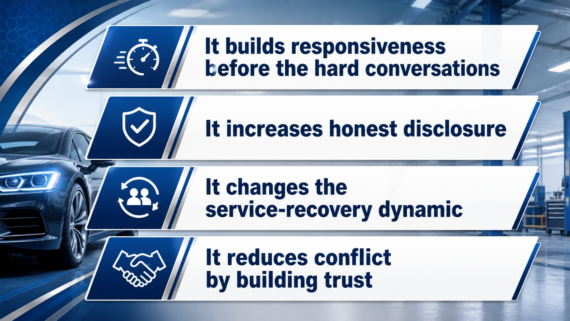
Research on question-asking consistently shows that people who ask more questions — especially follow-up questions — are better liked by their conversation partners. This happens because those questions increase perceived responsiveness, or the sense of being listened to, understood, and cared for. In collision repair, the customer needs accurate information. However, they also need to feel the relationship is safe enough to carry that information. Both matter.
A shop that opens with “What has been most stressful so far?” or “Would you like the repair side first or the insurance side first?” is not wasting time. Instead, it is building the trust that helps later technical explanations land more effectively.
- It increases honest disclosure
How questions are phrased affects what customers are willing to share. Neutral questions — ones that do not suggest a preferred answer — lower impression-management pressure. As a result, customers are more likely to be candid about cost concerns, schedule constraints, insurer confusion, or worries about hidden damage.
For example, a question like “What matters most to you here — timing, avoiding surprises, understanding the process, or repair quality?” sends a very different signal than a declarative explanation that assumes the answer.
- It changes the service-recovery dynamic
Service-recovery research shows that active listening — hearing the customer’s concern before responding and then acknowledging it — increases perceived fairness and customer satisfaction after a service failure. In addition, firm-initiated voice, where the shop proactively invites the customer to speak, improves perceived justice more than waiting for the customer to raise a complaint.
Collision repair involves many service-recovery moments, even when the shop did not create them. Delays, supplements, parts issues, and out-of-pocket surprises all require fresh recovery within the larger claim. Therefore, if the shop waits until those moments to start listening, the relationship is already under stress. Questioning works best when it is built in before the hard conversation begins.
- It reduces conflict by building trust
Trust matters most under conditions of vulnerability and uncertainty — which is exactly the environment collision customers face. Shops do not need trust because it sounds good. Instead, they need it because it reduces conflict, improves disclosure, increases cooperation, and keeps the customer aligned with the repairer when insurers create friction.
3. The estimate visit: same customer, two outcomes
Consider Sarah, arriving for an estimate after a rear-end collision in a drivable Honda CR-V. She is frustrated with her insurer, worried about cost, uncertain about timing, and strongly wants to avoid surprises.
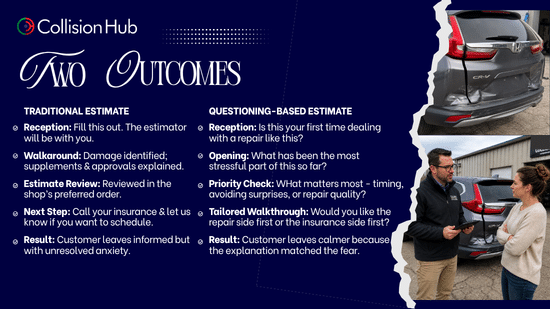
Both versions may cover the same ground. However, what differs is the sequence. The traditional interaction leads with expertise, while the questioning interaction begins with discovery and then applies that expertise to the concern the customer has already surfaced.
As a result, that shift moves the customer’s experience from being managed to being guided.
4. Micro-agreements: small questions that build bigger trust
Small questions early create small agreements. As a result, those agreements teach the customer that this relationship is interactive — not one-sided.
Micro-agreements are low-pressure questions asked early that create a pattern of participation before the conversation becomes difficult. They are not manipulation. Instead, they act like relationship signals.
Questions like “Is this your first repair like this?”, “What has been most stressful so far?”, “Do you want short updates or more detail?”, and “Would you rather hear about issues early, even if we do not yet have every answer?” accomplish two things at once. First, they establish a habit. The customer answers, clarifies, and participates. Second, they generate predictive information the shop can use later.
If the customer says timing is the biggest concern, later updates can be framed around timing. For example: “You mentioned timing matters most — I wanted to call as soon as this parts delay affected the schedule.” Likewise, if the customer says avoiding surprises matters most, the shop has clear permission to raise issues before it has every answer. In this way, the customer’s earlier priorities become the frame for every subsequent update.
From a psychological standpoint, micro-agreements make engagement feel normal before tension arrives. From a business standpoint, they make later communication more efficient. As a result, the front office stops guessing how to frame updates because the customer has already defined what matters most.
5. Questioning and insurer-induced friction
Questioning also changes the politics of repair planning. In a traditional model, the shop presents a plan and the customer receives it. As a result, insurer pushback is often framed as a dispute between the carrier and the shop. A questioning model creates a different alignment.
When the shop asks how the customer wants their property handled, what matters most in the repair, and what they most want to avoid, those questions create ownership. As a result, when insurer disagreement appears, the carrier is no longer resisting only the shop’s supplement. Instead, it is resisting the customer’s stated direction for their own property. This shift makes it much harder for insurer friction to pull the customer away from the shop.
The strategic goal is not to win a conversation against the carrier. Instead, it is to keep the customer and the shop on the same side of the conversation when claim friction appears.
6. What this looks like in practice
- Build questioning into every customer moment, not just the hard ones
Questioning should be part of first contact, estimate intake, repair planning, drop-off, updates, supplements, delivery, and follow-up. If staff train only for bad-news calls, they prepare the relationship after it is already under stress.
- Track what genuinely signals communication health
Shops should track more than CSI. For example, useful indicators include close rate, rehash calls, frequency of escalations, supplement-call outcomes, staff comfort with difficult conversations, and whether updates reference the customer’s stated priorities.
- Rewrite the phrases that increase abandonment
Phrases like “There’s nothing we can do,” “That’s insurance,” and “Call your adjuster” tell the customer the shop has stopped working for them. Instead, responses that preserve agency work better. For example: “Let me make sure I address the right concern first” or “Would it help if I walk you through what happened and what comes next?”
- Document what the customer tells you
Micro-agreements only scale if the shop captures the answers in the file. A simple set of fields — biggest concern, preferred update style, explanation order, and tolerance for early warning — can improve communication consistency across every touchpoint.
The bottom line
In a business where everyone else already tells customers what to do, the shop that asks better questions becomes the shop the customer trusts.
Collision customers are not simply purchasing labor, parts, and paint work. Instead, they are purchasing clarity in the middle of chaos. The old front-office model — professionalism defined by explanation density — is no longer enough. Do not train the front office only to explain the process. Train it to learn from the customer in a structured way, early and often. That is where trust begins, friction lowers, and the shop becomes genuinely different from every other voice telling the customer what to do.