
The Judgment Gap:
New Podcast Series on AI in Collision Repair and Insurance Claims
Collision Hub has launched The Judgment Gap, a new 18-part podcast series examining the growing role of AI in collision repair and insurance claims—and what organizations may be losing as software and automation increasingly provide the answers.

September 3, 2026 — Collision Hub launched a new 18-part podcast series examining one of the most important questions facing collision repair and insurance claims today:
If we have more information, more software, more automation and faster access to answers than ever before, why does the work not always seem to be getting better?
The new series, The Judgment Gap, is hosted by Collision Hub founder Kristen Felder and serves as a companion to her book, The Judgment Gap: What Collision and Claims Are Quietly Losing as AI Takes Over the Answers.
Episode 1, “The Judgment Gap — Why More Answers Are Not Making Work Better,” is available now.
Watch Episode 1:
https://youtu.be/C5Qtd75s1kk
The series arrives as artificial intelligence and automation are rapidly changing both sides of the automotive insurance claim.
Insurance companies are expanding the use of AI for claims intake, image analysis, damage assessment, file summaries, workflow routing and decision support.
Collision repair businesses are also asking technology companies for faster estimating tools, automated repair planning, AI-assisted documentation and software that can reduce administrative workload as shops struggle with staffing, complexity and time. Yet dissatisfaction is growing at the same time.
Recent Glassdoor research examining employee discussions of artificial intelligence found that 98% of AI mentions by insurance claims adjusters were negative, an unusually high level of negative sentiment compared with workers overall.
Adjusters have described technology that can create additional work when automated information must be corrected, reviewed or investigated by a human.
Collision repairers are experiencing the issue from another direction.
Shops regularly encounter vehicles where an initial photo estimate, automated damage assessment or remotely generated estimate does not reflect the full repair requirements discovered once the vehicle is physically inspected and disassembled.
That creates a strange paradox. Both industries have asked technology to make the work easier. Both industries have received more technology. And both sides increasingly complain that the work is becoming harder.
Felder believes the industry may be asking the wrong question. Maybe better work was never simply about having access to more information. Maybe the missing element is judgment.
More Information Has Not Automatically Created More Capability
- Repair procedures can now be searched in seconds.
- Insurance policy language is available digitally.
- Regulations and statutes can be accessed online.

- Estimating platforms provide prompts and automated recommendations.
- Training can be delivered on demand.
- Artificial intelligence can summarize a claim, analyze information and produce a polished response almost instantly.
By almost any measure, collision repairers and insurance claims professionals have more access to information than any previous generation of workers. That should theoretically produce the most capable workforce the industry has ever seen. But that assumption is at the heart of The Judgment Gap.
The opening episode asks why post-repair inspections can still uncover problems, why claims decisions continue to become complaints and litigation, why estimates can miss important vehicle damage or necessary operations and why experienced professionals can often see something in a file that a technically correct process failed to recognize.
The problem, Felder argues, is that organizations have often confused access to an answer with the capability to evaluate and apply that answer.
“The answer is getting cheaper. The judgment is not.”
That distinction becomes increasingly important as AI-generated information becomes embedded in collision repair estimating and insurance claims handling.
The Judgment Gap Is Not an Anti-AI Series
Despite the subject matter, Felder says the new podcast is not an argument against artificial intelligence. It is an argument for understanding where AI works, where humans work and what happens when organizations stop developing the human capability necessary to evaluate machine-generated answers.
AI can be extraordinarily useful.
It can search large amounts of information, summarize documents, reduce repetitive administrative work, identify patterns and help employees retrieve information faster than traditional systems. But speed of retrieval is different from judgment.
A machine can provide an answer. A trained professional still has to determine whether that answer fits this vehicle, this repair, this policy, this claim, this jurisdiction and this set of facts. That distinction becomes especially important when the answer sounds convincing.
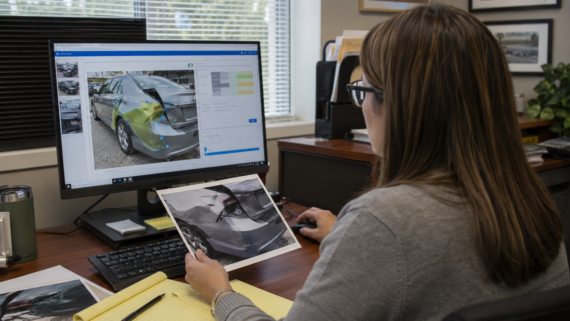 One of the episodes in the series, “The Fluent Wrong Answer,” examines the danger created when an AI-generated response sounds equally confident whether the underlying conclusion is right or wrong.
Other episodes look at a second problem: what happens to human capability when technology becomes so convenient that employees stop practicing the reasoning the technology now performs for them.
The series examines research and lessons from cognitive science, learning, expertise, automation dependence, human factors and decision-making rather than relying only on opinion about where AI may be headed.
It also brings that research directly into the daily reality of collision repair and automotive insurance claims.
An 18-Part Examination of How Humans Actually Become Capable
Rather than treating AI as an isolated technology problem, The Judgment Gap series begins with a more fundamental question:
How does a human being actually become capable of handling complex work?
The 18 episodes move progressively from diagnosis to solution. Early episodes challenge assumptions about training and information.
Episode 2, “Nobody Wants to Be Trained,” examines what employees may actually mean when they repeatedly ask someone to “just tell me what to do.” The problem may not be an unwillingness to learn. Employees may be asking for help at the exact moment uncertainty appears in the work.
Episode 3, “Judgment Is Not Downloaded,” explores the difference between completing training and developing the experience, pattern recognition and reasoning necessary to handle an unfamiliar situation.
Episode 4, “Reading Is Not Understanding,” separates reading, comprehension, transfer and execution — four capabilities that organizations often incorrectly measure as one.
The series then moves directly into artificial intelligence.
Episodes examine AI hallucinations and confident wrong answers, cognitive offloading, automation dependence and what happens when companies outsource too much of the judgment that once existed inside their workforce. But the series does not stop with identifying the problem.
The middle episodes introduce a different model for organizational learning and support: The Answer Department.
From the Training Department to the Answer Department
One of the central concepts introduced in both the book and podcast is the idea that organizations may need to rethink the traditional relationship between training and work.
Companies have spent decades building training departments designed primarily around teaching employees what they need to know before they encounter a problem.
Felder argues that modern organizations also need a system capable of helping employees determine what to do when the real problem is sitting in front of them.
That is the role of the Answer Department.
It is not simply a chatbot. It is not a searchable document library. And it is not a replacement for training.
Instead, it is an operating model for capturing expert judgment, delivering appropriate guidance at the point of work, escalating high-consequence decisions and returning what the organization learns from difficult cases back into the system.
The series explores how organizations can give employees answers without creating dependence, how experienced professionals can transfer judgment before they retire or leave, and how companies can preserve institutional expertise that cannot simply be written into a procedure.
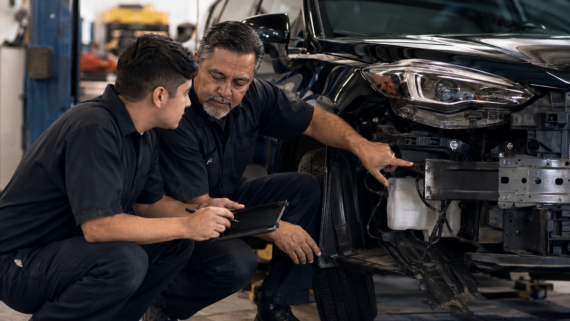
Episode 9, “Capturing Judgment Before It Walks Out,” examines a growing problem across both claims and collision repair: what actually disappears when the most experienced person leaves the organization.
- The procedures remain.
- The software remains.
- The old estimates remain.
- The training materials remain.
But the person who knew which fact mattered, which answer did not fit and which question nobody had thought to ask may be gone.
That is not merely information loss. It is judgment loss.
AI in Insurance Claims and Collision Repair Is Also a Business Issue
Later episodes move the conversation from training and workforce development into business strategy.
“The Green Dashboard Problem” examines how organizations can report excellent training completion, software utilization or productivity metrics while the actual quality of the underlying work remains weak.
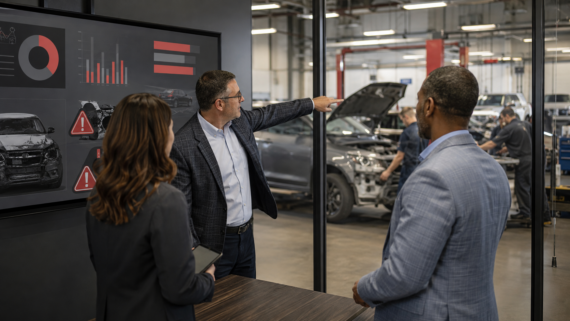
“The Cost of Inaction” asks executives to identify where lost judgment is already appearing financially under other names:
- Rework.
- Supplements.
- Rental expense.
- Customer complaints.
- Repeated claim handling.
- Missed repair operations.
- Turnover.
- Vendor dependence.
- Legal expense.
- Outside experts.
- Lost revenue.
- Management time.
- And potentially unsafe repairs or incorrect claims decisions.
Another episode, “Judgment as Competitive Advantage,” asks an even larger strategic question.
If every collision repair company can eventually purchase similar AI estimating software, and every insurance carrier can subscribe to similar claims automation systems, what becomes the actual competitive advantage?
Software can be purchased. Data can be licensed. Equipment can be installed. AI will increasingly become available to everyone. Judgment is different.
It develops through years of exposure to real claims, real repairs, exceptions, disputes, unusual failures and consequences. When everyone can buy the answer, the advantage may belong to the organization that still knows when the answer does not fit.
The Series Also Challenges Its Own Argument
The Judgment Gap does not present the concept as an unquestionable theory.
Episode 16, “The Best Case Against,” deliberately challenges the framework.
Is the Answer Department simply performance support under another name? Could a system designed to provide answers actually create even greater dependence? Is research surrounding AI and cognitive decline mature enough to justify sweeping conclusions? Does some work require deep knowledge before an employee ever encounters the situation? Could capturing an expert’s judgment become a way for companies to extract that person’s value and make the expert easier to replace?
Felder argues that an idea about judgment should be willing to survive judgment itself.
The final episodes therefore move beyond theory and into controlled implementation.
“The First Ninety Days” explores how an organization could begin identifying, capturing, preserving and measuring judgment without purchasing a massive new platform or launching a company-wide transformation.
The final episode, “The Answer Is Not the End,” brings the argument back to one central idea: The goal is not simply to create better answers. It is to create and preserve humans who know what to do with them.
The first episode of the 18-part series, “The Judgment Gap — Why More Answers Are Not Making Work Better,” launches the larger conversation by examining the paradox facing collision repair and insurance claims.
The industry has spent decades improving access.
- More training.
- More procedures.
- More estimating software.
- More claims technology.
- More automation.
- More data.
- And now more artificial intelligence.
The question is no longer whether the industry can get an answer. The question is whether the person receiving it has enough knowledge, context and judgment to determine whether it is the right answer.
Episode 1 is available now on Collision Hub’s YouTube channel:
New announcements will accompany each episode as the 18-part series continues.
About The Judgment Gap
The Judgment Gap: What Collision and Claims Are Quietly Losing as AI Takes Over the Answers is written by Kristen Felder, founder of Collision Hub.
The book examines the intersection of artificial intelligence, collision repair, insurance claims, training, expertise and human decision-making.
Rather than arguing against technology, The Judgment Gap explores how organizations can use increasingly powerful AI and automation without allowing the human knowledge necessary to question, verify and correctly apply those answers to disappear.
Learn more about the book:
https://collisionhub.com/book-summaries/ai-collision-repair-insurance-claims-judgment-gap/