What Collision Repair Is Quietly Losing
As the FTC examines AI accuracy, The Judgment Gap asks what collision repair and insurance claims are quietly losing as AI takes over the answers.
Answers Are Cheap. Judgment Is Not. Now Regulators Are Asking About the Cost.
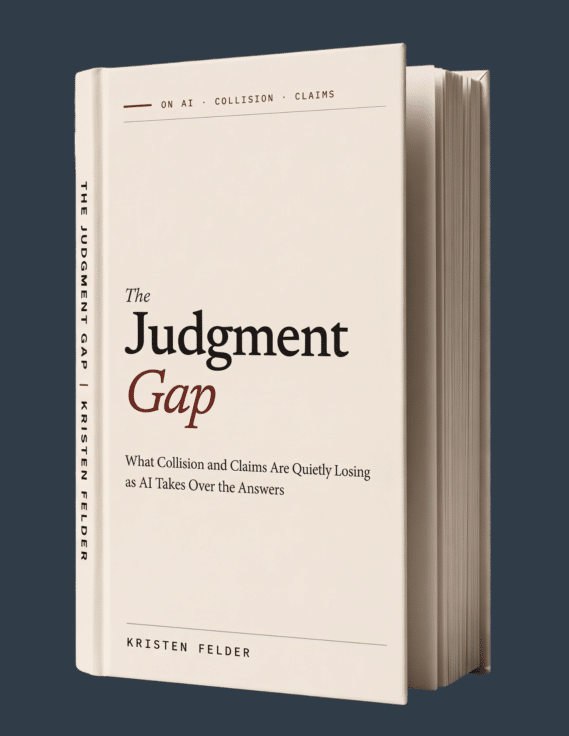
With the FTC seeking public input on AI accuracy, my new book, The Judgment Gap, arrives at the question collision repair and insurance claims cannot afford to ignore: when AI gives the answer, who still knows whether it is right?
Artificial intelligence is rapidly changing collision repair and insurance claims. AI systems now help review vehicle damage, write estimates, interpret claim information, recommend coverage decisions and guide employees toward an answer. But as the Federal Trade Commission examines AI accuracy, the industry must confront a more important question: when AI gives the answer, who still knows whether it is right?
The Federal Trade Commission is now asking for public input on AI accuracy.
That should matter to every collision repairer, insurer, claims leader, technology vendor, trainer, consultant, and business owner using artificial intelligence to help make decisions that affect consumers.
Because AI accuracy is not an abstract technology issue.
In the real world, a bad AI answer can become a bad claim decision or a bad repair decision. A safety issue that follows a repaired vehicle back onto the road.
That is why I wrote The Judgment Gap.
I did not write this book because I am against AI. In fact, the book started 15 years ago before AI was part of the research.
I wrote it because I have spent more than three decades in collision repair, insurance claims, training, consulting, and litigation support, and I am watching the industry race toward answer systems faster than it is protecting the human judgment required to use those answers correctly.
There has never been a time when answers were easier to get.
Repair procedures are searchable. Policy language is searchable. Regulatory text is searchable. Estimating information, training material, customer communication scripts, and the collected knowledge of entire professions are available in seconds.
And now AI does more than retrieve the answer.
It writes one.
By any reasonable expectation, that should have made us more capable.
But that is not what I have watched happen.
The work is getting more technical, more regulated, more fragmented, more automated, and more consequential. At the same time, many of the human systems that once developed judgment have been weakened or removed: mentoring, field exposure, complete file ownership, claims schools, experienced supervisors, real-world correction, and the hard lessons that come from seeing the consequences of a decision.
The answer is getting cheaper.
The judgment is not.
That is the gap.
It is the space between having an answer and knowing whether that answer should become an action. And it’s not simply explained away by terms such as ‘Human In The Loop’.
In collision repair and insurance claims, that gap can become expensive, unsafe, indefensible, and dangerous.
This Is Not a Book Against AI
Let me be clear.
I am not arguing against artificial intelligence.
I am not arguing against technology, automation, training, speed, or efficiency.
I am arguing against confusing any of those things with capability.
AI can summarize, classify, compare, recommend, and draft faster than any person in the room. But the most important question in claims and collision repair is not simply, “Can we get an answer?”
The question is:
Who still knows whether this answer is right for this specific claim, this specific repair, this specific vehicle, this specific customer, and this specific moment?
That is where judgment lives.
AI can produce a fluent answer. But fluency is not proof of truth. A professional tone is not proof of accuracy. A fast response is not proof of application. A confident recommendation is not proof that the person receiving it understands the consequence.
That is why the human role matters more, not less, as AI takes over more of the answers.
What Collision Repair Is Quietly Losing
Collision repair is no longer a trade that can survive on general familiarity and visual judgment alone.
Modern vehicles are rolling networks of materials, sensors, software, structural engineering, advanced driver assistance systems, calibration requirements, and manufacturer-specific repair procedures.
The correct answer may exist in the procedure.
But that does not mean the person reading it can interpret it, connect it to the actual vehicle, identify the related operations, build it into the estimate, explain it to the insurer, and make sure it is performed correctly.
Access is not application.
A shop can have the procedure and still miss the repair.
A technician can complete training and still be placed inside a pay structure that penalizes the careful work.
An estimator can attach documentation and still fail to translate it into the repair plan.
A manager can believe the system is working because the dashboard is green while the actual capability underneath it is quietly eroding.
That is one of the hardest truths in the book.
Compliance is not capability.
Documentation is not judgment.
Having the answer is not the same as knowing what to do with it.
What Claims Is Quietly Losing
Claims is facing the same problem from a different direction.
For years, claims work has been broken into smaller and smaller pieces. One person opens the claim. Another reviews photos. Another handles valuation. Another approves payment. Another responds to an escalation. Another reviews compliance. Another handles litigation after the decision has already created the problem.
Fragmentation can create efficiency.
It can also destroy the feedback loop that teaches judgment.
The adjuster who never sees the full consequence of a weak decision does not build the pattern library that older claim environments once produced. The employee who is trained to follow the workflow may stop asking whether the workflow produced a fair, defensible, contractually correct result.
And now AI enters that environment with fluent answers.
That does not automatically close the judgment gap.
It can widen it.
The danger is not simply that AI can give a bad answer. People give bad answers too. The danger is that AI gives a confident answer that sounds complete, looks professional, and arrives fast enough that no one slows down to ask whether it fits the facts.
That matters when the answer affects a consumer.
It matters when the answer affects safety.
Why I Wrote This Now
Truth is, the research was not complete. This book is not really ready. I am releasing The Judgment Gap because I believe the industry is standing at a dangerous point of confusion.
Employees are asking for answers because the work has become too complex and too fast-moving to rely only on traditional training models.
Companies are rushing to build answer systems because they need speed, scale, consistency, and lower dependency on scarce expertise.
Technology vendors are offering tools that promise to make the work faster and easier.
All of that is understandable.
But none of it removes the need for judgment.
If anything, it makes judgment more important.
The organizations that survive the next ten to twenty years will not be the ones with the most answers. Everyone will have answers. The survivors will be the ones that know which answers are correct, which are incomplete, which are stale, which are misapplied, and which should never become a decision without human review.
That is the larger warning in this book.
AI is answer-first by design.
So if a business is going to operate in an answer-first world, it needs a process that builds judgment into the answer before the answer becomes action.
That means classifying answers.
Preserving expert reasoning.
Creating escalation paths.
Documenting governance process.
Measuring capability.
And most importantly, protecting experienced people before they are downsized or retire.
Making sure the human in the loop is not just a buzzword, a signature, a click, or a person blamed when the decision goes wrong.
The Human Bridge
One of the most important ideas in the book is what I call the human bridge.
AI may produce the answer.
But a human must still bridge the distance between the answer and its correct application.
That bridge includes context, consequence, experience, technical understanding, regulatory awareness, ethical awareness, and the courage to say:
This answer does not fit.
That is the role organizations cannot afford to lose.
Because once experienced people leave, retire, burn out, or are replaced by systems that no longer require them to exercise judgment, the organization may not immediately notice what it has lost.
The work may still move.
Files may still close.
Estimates may still be written.
Customers may still receive responses.
Dashboards may still look green.
But when the exception arrives — the case that does not fit the model, the repair that requires deeper understanding, the claim that becomes litigation, the AI output that is confidently wrong — the organization discovers whether judgment still exists inside the system.
This Book Comes From Inside the Work
I did not write this as an outsider looking at collision and claims from a distance.
I wrote it from inside the work.
I grew up in body shops. I worked in insurance claims. I managed claims. I built training. I delivered training. I have worked with shops, insurers, attorneys, consultants, and industry leaders. I have watched people make good decisions under pressure, and I have watched organizations make it harder for good people to develop the judgment the work requires.
I have seen training work.
I have also seen training fail because it was treated as an event instead of a developmental system.
I have seen employees blamed for not knowing what the organization never gave them enough support to learn.
I have seen companies mistake compliance for capability.
I have seen experts carry entire operations in their heads while leadership failed to capture what those people knew before they walked out the door.
And now I am watching the industry rush toward AI answer systems without fully measuring what happens when the human capacity to question those answers gets thinner.
That is why this book matters to me.
It is not just about AI.
It is about what happens to an industry when the answers get faster, but the people become less prepared to judge them.
Who I Wrote It For
I wrote The Judgment Gap for shop owners trying to preserve repair quality in a market that rewards speed and cost control.
I wrote it for claims leaders who know their teams are under pressure but also know that process compliance does not equal good claim handling.
I wrote it for training leaders who are tired of being asked to solve operational problems with another course.
I wrote it for executives trying to understand what AI should do, what it should never do alone, and what kind of human capability must remain inside the business.
I wrote it for attorneys, consultants, and industry professionals watching the gap between technical complexity and human understanding become a source of risk.
And I wrote it for every person in this industry who has ever looked at a confident answer and thought:
That sounds right, but something about it does feel right.
That instinct matters.
That instinct is judgment.
Available Now
The print edition of The Judgment Gap: What Collision and Claims Are Quietly Losing as AI Takes Over the Answers is now available for order.
This book is about AI, but it is really about people.
It is about the people who still know how to think through the exception.
The people who know when the procedure does not match the damage.
The people who know when a claim decision may be fast but not defensible.
The people who know when the system’s answer is not enough.
The people every organization is going to need more, not less, as AI takes over more of the answers.
Because answers are instant.
Judgment is earned.
And the gap is growing.