



Description
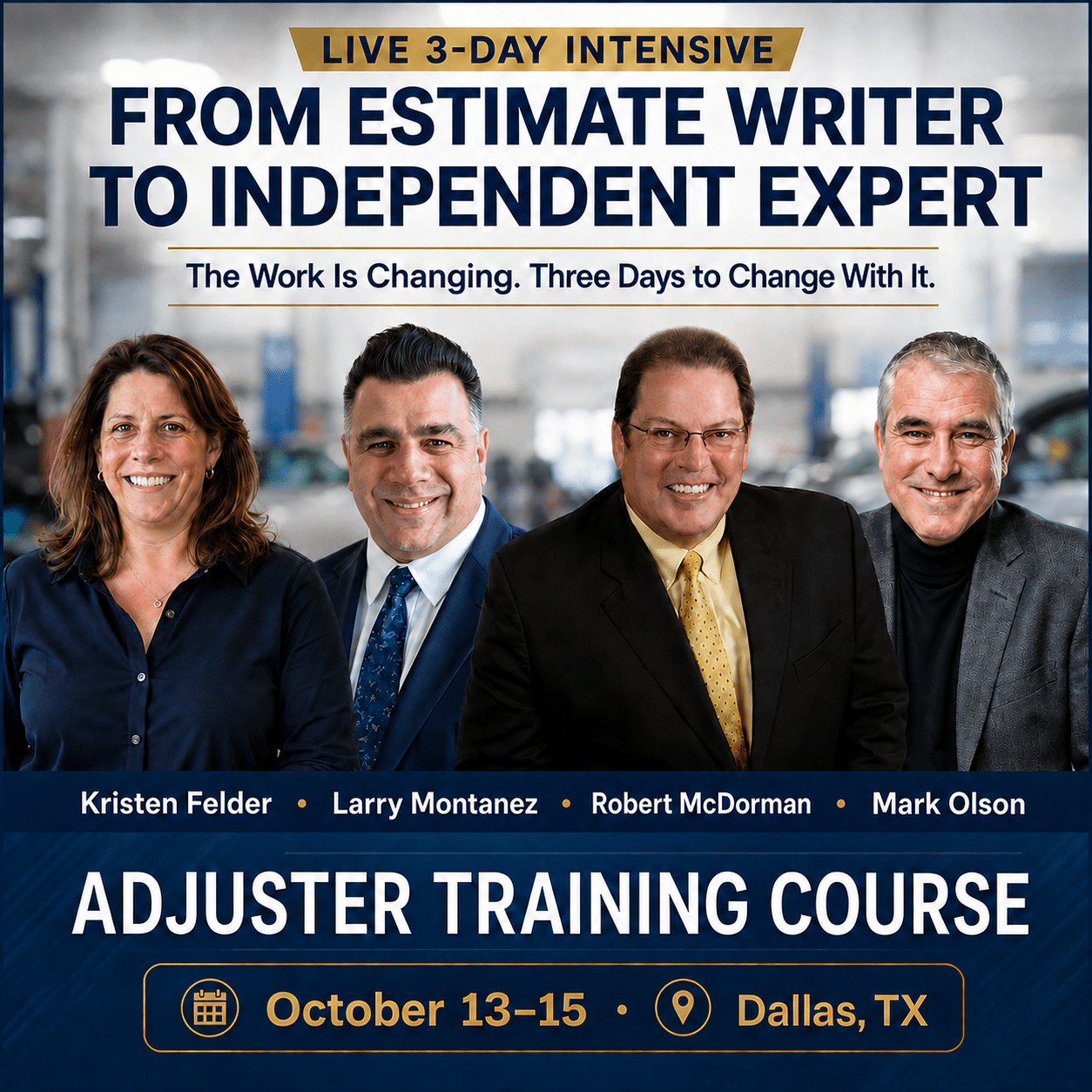
The Work Is Changing. Three Days to Change With It.
A three-day, live continuing education intensive for independent adjusters, public adjusters, and auto appraisers.
October 13–15, 2026
The Slate
2403 Farrington St.
Dallas, TX 75207
Every service you get paid for comes down to one important question: Will your professional opinion hold up when someone pushes back?
That may be an appraisal award. It could be a market survey supporting a value the carrier disputes, a diminished value calculation, a report explaining manufacturer repair requirements, or a memo for a retaining attorney.
These may be different products, but they all require the same discipline: a documented, defensible professional opinion that forces an opposing reader to respond rather than simply dismiss it.
During this three-day, in-person course, you will learn how to strengthen that work, expand your professional capabilities, and better understand the limits of your expertise.
Day One: Policy Language and the Right to Appraisal
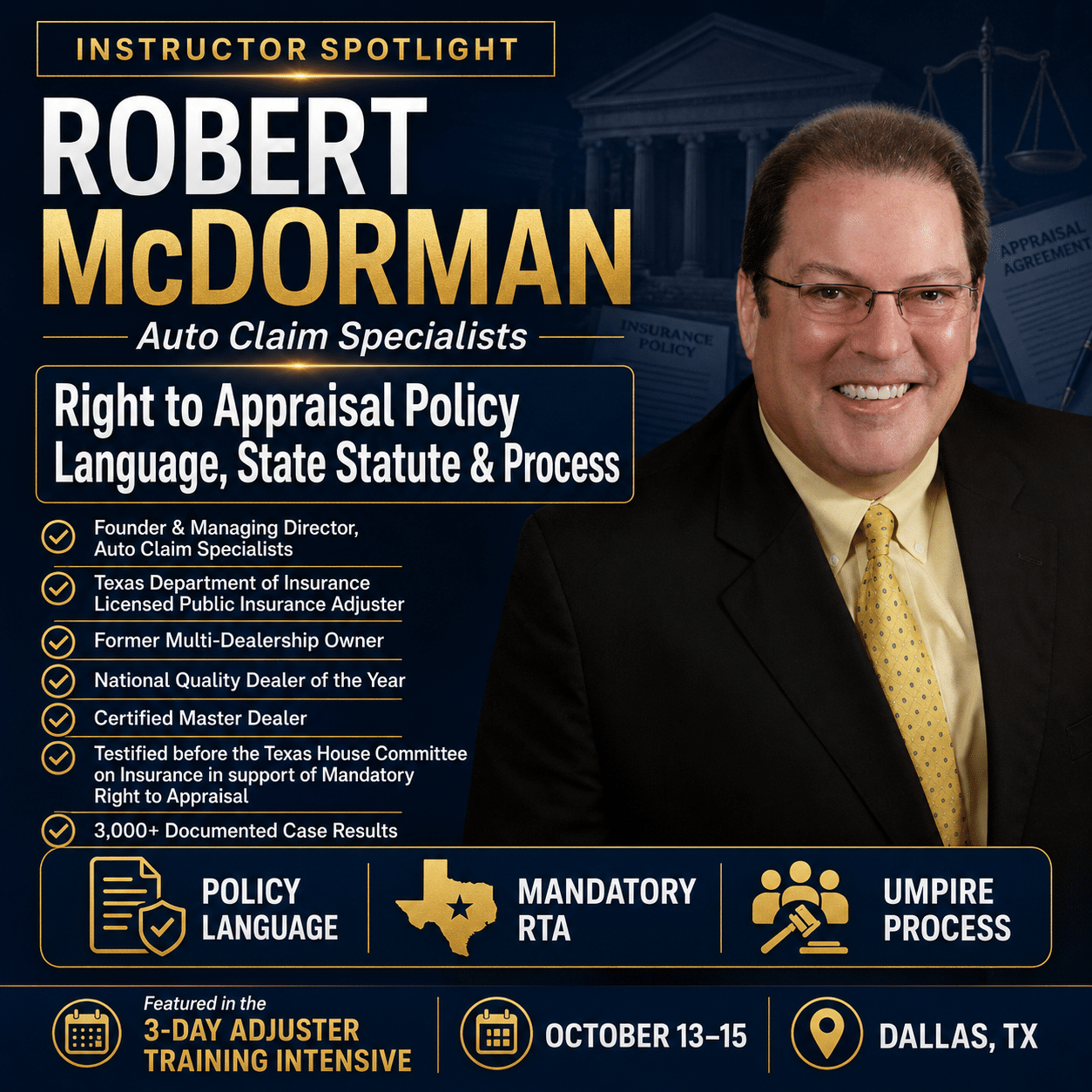
Appraisal makes up a large portion of independent work. However, policy language—not the estimating system or OEM repair procedures—often determines the outcome of a file.
Day One focuses on the policy provisions that directly affect appraisal outcomes rather than providing a general policy overview.
Topics include:
- Where the insurance contract establishes the Right to Appraisal
- How state statutes can create or affect the Right to Appraisal
- Why an RTA process that works in Texas may not work in another state
- How and when to properly invoke appraisal
- Appraiser competence and impartiality
- How parties may challenge an appraiser’s qualifications or impartiality
- How to select an umpire and understand the umpire’s role
- What appraisers settle versus what the umpire decides
- How to carry an appraisal through to a binding award
- How improper conduct can compromise the appraisal process
The goal is to help you understand not only how appraisal works, but also the authority behind the process.
Day Two: Independent Expert Reporting — ACV, Diminished Value, and Repair Requirements
Day Two focuses on three report products that use the same professional framework.
Actual Cash Value
Learn how to construct an actual cash value market survey that can withstand scrutiny. You will also learn how to examine and challenge carrier valuation reports.
Diminished Value
Explore how to calculate diminished value honestly and support your conclusions. This includes a frank discussion of the commonly used 17c formula and why relying on it uncritically can become a liability.
Independent Expert Repair Reports
Independent expert reporting on vehicle repair requirements offers a rapidly growing area of opportunity.
These reports serve a similar function in auto claims to engineer reports in homeowner claims. In some cases, an independent repair report may provide the customer’s only leverage when the policy contains no appraisal clause and state law does not compel appraisal.
Throughout Day Two, you will also learn the authority hierarchy that separates a defensible professional opinion from a simple assertion.
That includes:
- Manufacturer repair procedures
- Manufacturer position statements
- Estimating database documentation
- Not-included operations
- Product technical data sheets
- Properly citing supporting documentation
- Creating reports that allow the reader to verify your conclusions
- Understanding the line you cannot cross when giving a professional opinion
Day Three: Accident Investigation and Vehicle Data in Litigation
Attorneys increasingly retain automotive professionals for both civil and criminal matters. At the same time, relatively few people can perform this work credibly.
Day Three explores this growing area of automotive expertise.
You will learn what information an attorney needs during the first phone call—before the vehicle goes to salvage or important module data becomes unavailable.
Topics include:
- Qualifying an attorney engagement
- Conducting a scene inspection
- Researching roadway standards
- Analyzing damage consistency
- Identifying the automotive expertise you can already provide
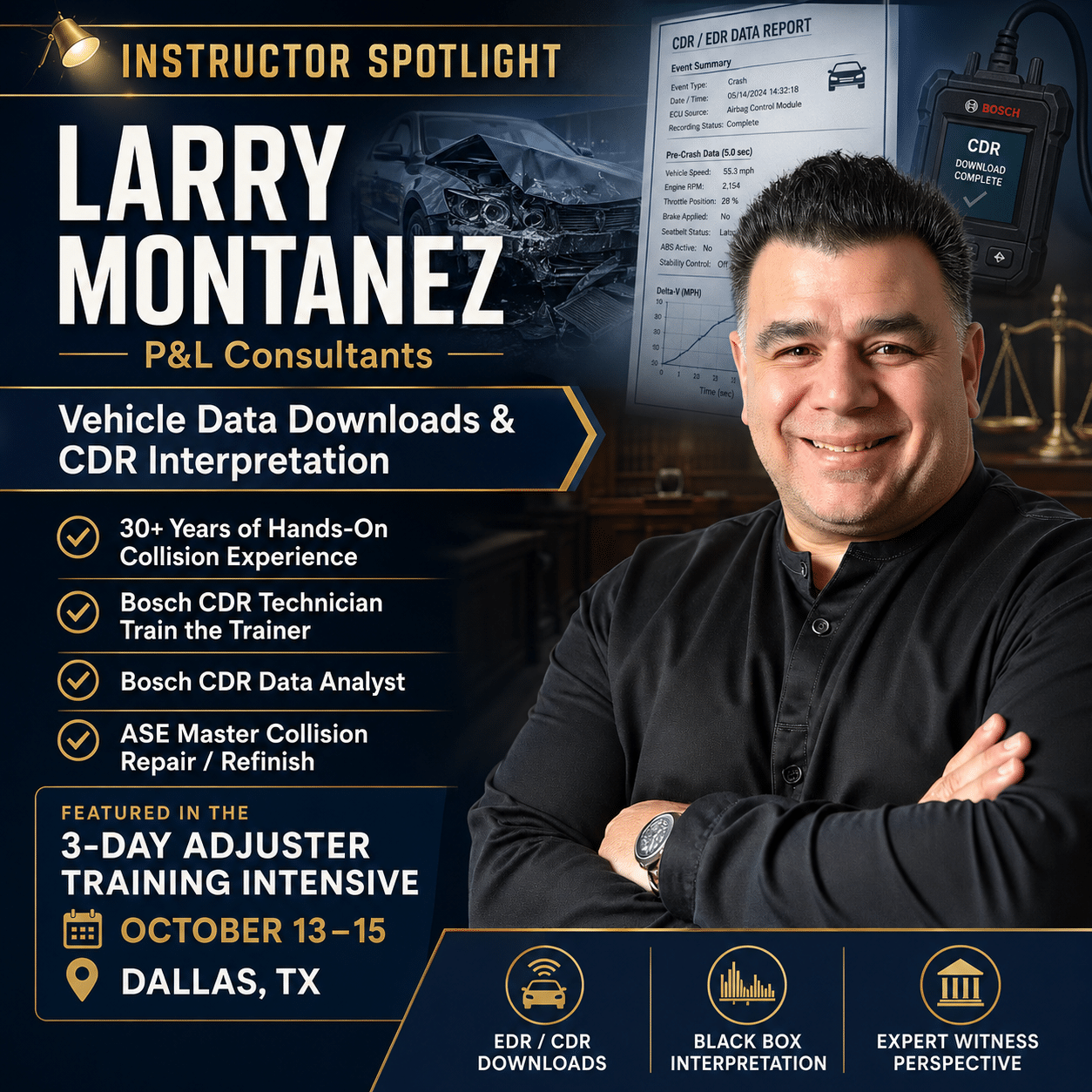
- Understanding vehicle data used in litigation
- Understanding Event Data Recorder (EDR) information in the airbag control module
- Distinguishing EDR information from data in vehicle infotainment systems
- Understanding why confusing EDR and infotainment data can damage a case
- Reading a CDR report produced under warrant
- Avoiding opinions that exceed your qualifications
- Recognizing when a case requires a certified analyst
Day Three uses real-world files and redacted case material from actual criminal and civil matters, including a CDR report from warrant production.
What You Will Leave With
This course focuses on practical training you can take directly into your work.
You will leave with report templates you can use immediately. You will also gain a clearer understanding of what your current credentials qualify you to say, how to support your professional opinions, and where your qualifications end.
The case-file format limits the number of available seats.
Who Should Attend?
This course is a strong fit for:
- Independent adjusters and auto appraisers who handle appraisals, total loss valuations, and diminished value claims
- Public adjusters who want to expand their automotive capabilities
- Collision estimators and shop personnel who want to move toward independent appraisal work
- Automotive professionals who receive inquiries from attorneys about accident investigation or vehicle data work
Please note: This course assumes you already know how to write an estimate and read a loss. It is not an introductory estimating or claims-handling class.
Cancellation and Refund Policy
Because we limit seating for this live event, please review the cancellation policy before registering.
You may request a refund up to 10 days before the event begins. We will not issue refunds within 10 days of the event start date. If the class sells out, all registrations become non-refundable, regardless of when you request a cancellation.
Frequently Asked Questions
Does this course qualify for adjuster continuing education credit?
No. This course does not qualify for adjuster continuing education credit.
What is the Right to Appraisal, and how does this course cover it?
The Right to Appraisal is a provision in most auto insurance policies that allows either party to demand an independent appraisal when the parties cannot agree on the amount of loss. Some states also provide or compel appraisal through statute.
Day One explains where the right originates, how to invoke it, how to select appraisers and umpires, and how to carry the appraisal process through to a binding award.
Do I need to be a licensed adjuster to attend?
No. You do not need an adjuster license to attend this course.
What is an independent expert repair report?
An independent expert repair report provides a documented professional opinion about what a vehicle’s repair requires.
The expert supports that opinion with sources such as manufacturer repair procedures, estimating database documentation, and product technical data.
These reports can serve a similar function to engineer reports in homeowner claims. They can become especially important when an auto policy does not contain an appraisal clause and state law does not compel appraisal.
Do I need CDR certification to attend Day Three?
No.
Day Three teaches you how to read and interpret CDR reports that others produce, qualify an attorney engagement, and recognize when you need a certified analyst.
This course does not certify you to image vehicles.
Is this course online or in person?
This is an in-person course held October 13–15, 2026, at The Slate in Dallas, Texas.