
When Experience Expires:
Why Laid-Off Collision Repair Leaders Need a Career Autopsy
This is no longer a handful of unrelated layoffs. From where I sit, it looks like the industry is going through a structural reset.
Collision repair, insurance claims, technology and supplier companies are eliminating experienced middle-management roles. Kristen Felder explains why displaced industry leaders need an honest career autopsy—and a plan for turning institutional knowledge into skills the current market will pay for.
I know the exact number matters deeply to every person who lost a paycheck. But I also believe the larger signal matters to all of us.
Companies are looking hard at positions that do not touch the customer, produce revenue, or show a direct return on the bottom line. Some of those jobs were built around relationships and processes that are now disappearing. It is fair to ask whether vendor-facing insurance teams are being reduced because many carriers no longer have the experienced claim staff, authority, or internal structure those teams were created to support.
That is bigger than a round of cost cutting. It points to the middle of the industry being hollowed out.
The Disappearance of the Middle
For most of my career, the collision and auto-claims world depended on experienced people in the middle.
They translated between insurers and repairers. They knew the DRP relationships, understood the reports, trained field staff, and helped shops make sense of changing expectations. More importantly, they carried history. They knew who to call, why a number looked wrong, and where a process usually broke down.
Those jobs had value because there were knowledgeable people on both sides who could use that support.
That has changed. Veteran adjusters and managers have retired or left. Training departments have been reduced. One person no longer owns the whole file. Decisions are being pushed into centralized work queues, automated rules, vendor platforms, and straight-through processes. Too many employees now see one small part of the claim instead of understanding the whole thing.
When an insurer no longer has a deep bench of experienced claim professionals, the outside team built to advise and support those professionals has fewer people to work with.
We are seeing the same pressure inside repair organizations. As claim volume slows and margins tighten, MSOs are asking a blunt question: does this role touch the car, the customer, the sale, or daily production? Jobs centered on coordinating, coaching, reporting, or overseeing become vulnerable when their contribution is hard to measure.
The industry is not only cutting people. It is removing entire layers of work.
A Flood of Experience Is Entering a Different Market
That leaves us with a growing group of unemployed professionals in their 40s, 50s, and early 60s. Many have spent 15 years or more inside one corporate system. They have respected titles, long resumes, strong contacts, and a deep understanding of how their former employer worked.
Then they start applying and discover that the outside market does not value those things in the same way.
I see the posts every day. People say no one respects their experience. Recruiters do not call. Applications disappear into automated systems. After enough rejection, it is easy to blame age, compensation, politics, or an industry that no longer appreciates knowledge.
Some of those concerns are legitimate. Age discrimination exists. A previous salary can scare off an employer. Networks can be closed and political.
But there is another possibility we have to be willing to face: the work that made someone valuable for the last 15 years may not be the work the market needs now.

Experience Has a Shelf Life
Experience is not one permanent asset that keeps increasing in value. It is a mix of judgment, relationships, habits, knowledge, and hands-on ability. Some of it grows stronger with time. Some of it expires.
Judgment often becomes more valuable. So does pattern recognition. The ability to anticipate consequences, manage conflict, teach, negotiate, and spot risk before others see it can be a tremendous advantage.
But knowledge tied to an old workflow, an old DRP structure, an obsolete reporting system, or relationships that came with a title can lose value faster than we want to admit.
Someone may know exactly how a large MSO managed insurer scorecards in 2016 and still be behind on current repair planning, OEM procedures, customer acquisition, AI-assisted estimating, data analysis, or the financial pressure facing independent shops today.
The same is true in paint and distribution. A former manager may know how to run a territory, defend a contract, and conduct a quarterly business review, but struggle to create demand, quantify account profitability, communicate online, or win business in a tighter market.
That does not make the person unintelligent, lazy, or unworthy. It means the market changed while they were becoming highly specialized in one version of it.
What Is a Career Autopsy?
When I say career autopsy, I am not talking about beating yourself up or blaming the person who was laid off.
I mean taking an honest look at what happened, what still has value, what has expired, and what needs to be rebuilt.
An autopsy starts with evidence, not with the conclusion we would prefer to reach.
So the useful questions are not just, “What title did I have?” or “How many years was I there?”
The questions I would ask are:
- What problems can I solve without the authority, systems, staff, and brand of my former employer?
- Which outcomes can I prove I personally influenced?
- Which skills would still be valuable if no one recognized my former title?
- What knowledge do I have that is current, transferable, and scarce?
- What knowledge is tied to a process or relationship that no longer exists?
- Where has the industry moved beyond me?
- What am I unwilling to learn because I believe my experience should be enough?
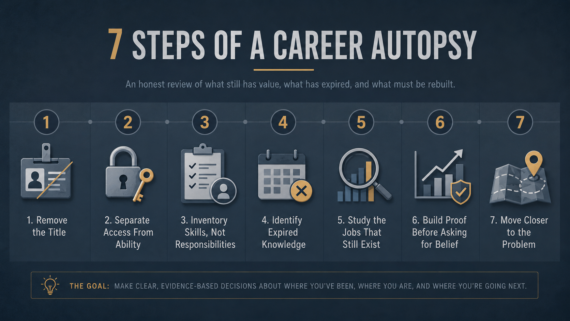
1. Remove the Title
Start by taking the titles off the resume and describing the work in plain language.
“Regional manager,” “insurance services director,” and “market vice president” are titles. They are not skills by themselves.
What did you personally improve? Did you grow revenue, retain accounts, improve gross profit, reduce cycle time, train people, solve claim friction, build a process, analyze data, recruit talent, or turn around a struggling operation?
Then ask the uncomfortable follow-up: can you still do those things yourself, or were you managing people who did them?
2. Separate Access From Ability
Corporate roles create access. A title gets the call returned. A known company opens the door. A budget gives you resources. A team may perform the technical work.
When the job disappears, some of that access disappears with it.
A contact list is not the same as a customer base. Sitting in meetings with decision-makers is not the same as influencing them without corporate leverage. Reporting performance is not the same as knowing how to create it.
The point is to separate what the organization allowed you to be near from what you can personally produce.
3. Inventory Skills, Not Responsibilities
Responsibilities tell me what the company assigned to you. Skills tell me what you can actually do.
“Responsible for 40 locations” does not tell a future employer much. “Found estimate-to-production breakdowns, coached managers, and improved labor gross profit by four points” does.
For every skill on the resume, ask three questions: Can I do it now? Can I prove it? Will someone pay for it?
4. Identify the Expired Knowledge
This is the part that takes the most honesty.
How much of your expertise depends on an old software system, an old carrier structure, a paint contract, a former DRP model, or relationships with people who have also retired or been laid off?
Which current topics do you avoid because you do not understand them well enough to discuss them with confidence?
Which job postings keep mentioning tools, measurements, or responsibilities you have never used?
Those are not personal attacks. They are useful findings.
5. Study the Jobs That Still Exist
Do not automatically search for your old title at another company. First, look at where companies are still spending money and hiring.
The more durable jobs tend to sit close to revenue, the customer, production, technology, compliance, or a problem the company cannot afford to ignore.
In collision repair, that may mean estimating and repair planning, technical training, ADAS and calibration processes, sales, customer acquisition, shop operations, recruiting, quality control, OEM certification support, data analysis, or financial performance.
The next job may carry a smaller title and still offer a more durable future.
6. Build Proof Before Asking for Belief
A rewritten resume is not enough. Employers need some reason to believe you have moved forward.
Take the course. Learn the platform. Build the dashboard. Write the process. Publish an analysis. Teach a class. Create a case study. Show measurable work.
Do not simply say you understand AI, ADAS, modern estimating, digital marketing, or shop financial performance. Create something that proves you do.
Current proof will carry more weight than asking an employer to trust a title from the past.
7. Move Closer to the Problem
This may be the hardest adjustment for a displaced manager. The next opportunity may feel more operational, customer-facing, or hands-on than the job that was lost.
Pride can turn that hesitation into long-term unemployment.
In a contracting market, the safest place is often close to a problem that makes or protects money. That may mean returning to a shop, selling directly, training technicians and estimators, managing customers, improving repair plans, or helping a business collect for work it already performs.
Moving closer to the work is not always moving backward. It may be the quickest way to become useful again.
The Difference Between Institutional Knowledge and Marketable Knowledge
I think the collision industry is about to learn an important distinction.
Institutional knowledge is knowing how one company works. Marketable knowledge is being able to solve a problem for more than one company.
Institutional knowledge can be extremely valuable while you are inside the organization. The day you leave, it may become much harder to sell.
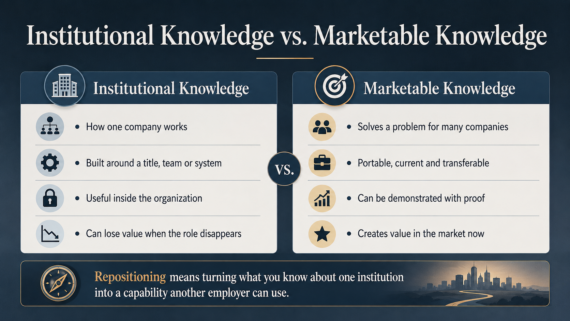
For example, knowing why a carrier created a particular audit rule, who approved it, and how the internal team used it is meaningful history. The marketable skill is being able to evaluate the rule, find false positives, explain the claim and repair consequences, and help another organization build a better control.
The same applies to MSO leadership. Knowing how one company ran regional performance calls is institutional knowledge. Walking into an underperforming shop, finding the cause, and improving the result is marketable knowledge.
Repositioning means turning what you know about one institution into a capability another employer or customer can use.
This Is Not an Argument Against Experienced Workers
I am not arguing that experienced workers no longer matter. I believe the industry needs them badly.
We need people who remember what complete claim ownership looked like. We need leaders who understand repairers, insurers, technicians, customers, and the consequences of a bad decision. We need judgment, pattern recognition, communication skills, and people willing to challenge a process that does not make sense.
But that experience has to create value in the present.
Experienced professionals do not need to pretend they are 28. Their advantage is mature judgment combined with current knowledge, modern tools, measurable execution, and enough humility to keep learning.
They can often see a pattern earlier, explain it more clearly, avoid an expensive mistake, and teach something that took decades to learn.
That is real value, but it has to connect to the work being done today.
The Question That Cannot Be Avoided
A person in their 50s may still need to work another 10 or 15 years. They do not have two years to spend defending the importance of a job that no longer exists.
The layoff may have been unfair. The company may have thrown away valuable knowledge. The market may be short-sighted. I am not dismissing any of that.
But the person still has to decide what comes next.
The question I would ask is not, “Why doesn’t the industry respect everything I have done?”
It is this:
“If I were hiring for the problems this industry will face over the next five years, would I hire myself based on the skills I can demonstrate today?”
If the honest answer is yes, tell that story and show the evidence.
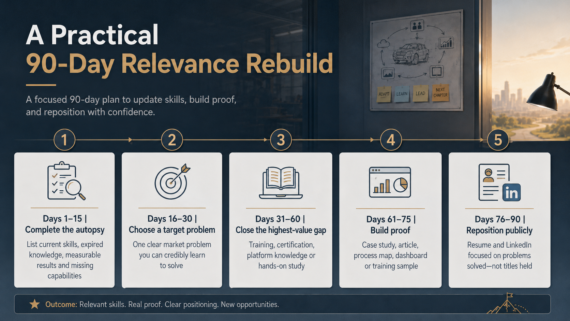
If the honest answer is no, that does not mean the career is over. It means the autopsy found the gap.
Now there is something concrete to rebuild.
The coming layoffs may flood the market with experience. They will not flood it with equal relevance.
My hope is that people use this moment to take an honest inventory, keep what still matters, update what no longer fits, and build a next chapter that the new market can actually use.