
NEWS & ANALYSIS
Allstate Patented a Different Way to Pay Collision Claims - And the Industry Never Paid Attention
A patent, a Canadian claims model and a wave of litigation point toward a collision economy that may no longer depend on the traditional estimate.
THE CLAIMS MODEL HIDING IN PLAIN SIGHT
For most of the last forty years, collision repair has revolved around the same basic process: a vehicle is damaged, someone inspects it, an estimate is written, and the repairer and insurer work through the differences until a payment is reached.
Technology has changed how that process happens. Photo-based estimating replaced some field
inspections. DRPs changed how claims are routed. Supplements moved into electronic portals. Artificial
intelligence is beginning to automate portions of estimating and claims review.
But underneath all of those changes, the basic architecture remains remarkably familiar. We still inspect
damage, determine the expected cost of an individual repair, document that cost and negotiate
disagreements.
An enormous industry has been built around that architecture. Billion-dollar software companies, estimating
platforms, claims organizations, repair networks, adjusters and estimators are all developing increasingly
sophisticated versions of essentially the same mousetrap.
“What if the next version of the auto claim does not require an adjuster reviewing individual repair decisions — or a shop producing the traditional written estimate?”
More importantly, what if insurers have already spent years developing and discussing economic models
that could make much of that possible while almost no one in collision repair was paying attention?
That is where the newest episode of Collision Coffee Talk begins.
The Patent
Allstate has a patent family involving insurance claim capitation and predictive payment modeling for
vehicle repair claims. Its history traces back to 2012, when Allstate still owned Sterling Collision Centers.
The language is worth reading carefully because this is not another version of a DRP program. The patent
describes a model in which an insurance company could pay a repair facility a fixed predicted capitated
amount for each repair claim, regardless of the amount of repair work ultimately required.
That changes the underlying economic question.
The traditional model asks what this vehicle costs to repair. A predictive or capitated model can instead ask
what a population of repairs should cost and who is willing to manage the financial variance within that
population.
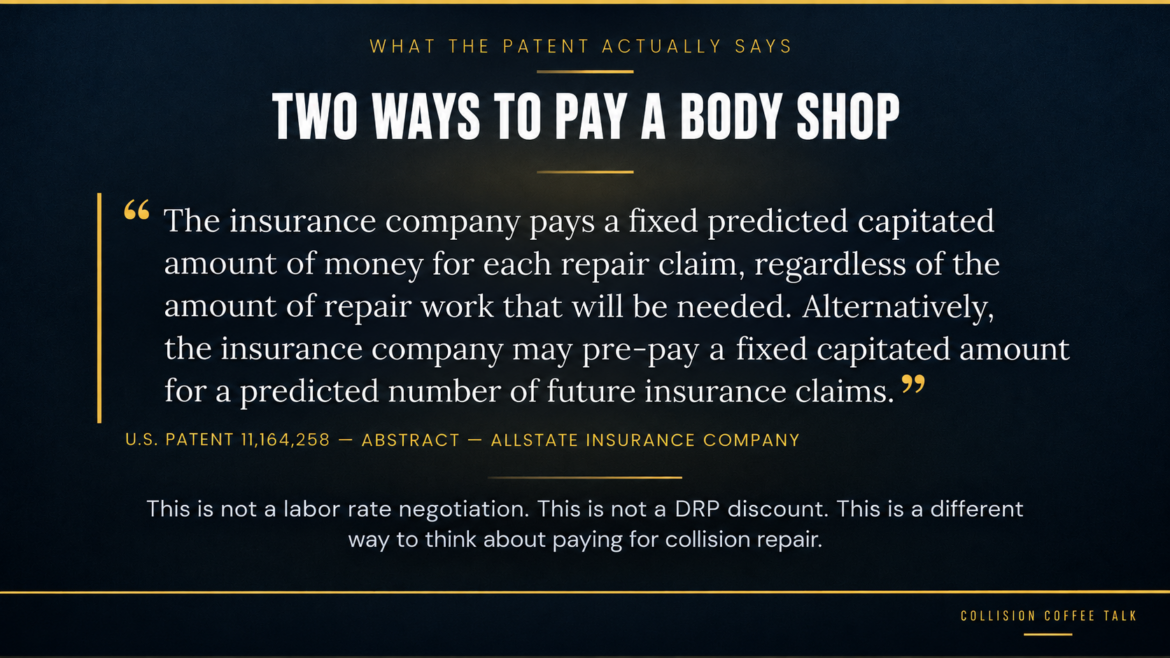
The patent describes fixed predicted payments for individual claims — and a pre-paid amount for a predicted number of future claims.
This is not a labor-rate negotiation. It is not a DRP discount. It is a different way to think about paying for collision repair
The Trail Goes Through Canada
Years before Allstate’s patent filings, ICBC was publicly discussing a different approach to repair-provider
economics in British Columbia. A 2004 legislative record documents questions about collision shops being
measured against average repair costs, with financial consequences tied to their performance. ICBC officials
described a broader performance model incorporating average repair cost, cycle time and customer
satisfaction.
Then, in 2015, the published agenda for the MSO Symposium in Detroit included a panel called Claims
Management Models. Representatives included ICBC, Ford Motor Company, Allstate and Assured
Performance Network. The advertised subjects included repair segmentation, certified repair centers, OE
certification, parts-purchasing models and capitation.
Representing Allstate on that panel was Clint Marlow. Marlow’s name also appears among the inventors
associated with Allstate’s capitation patent, along with Randy Hanson.
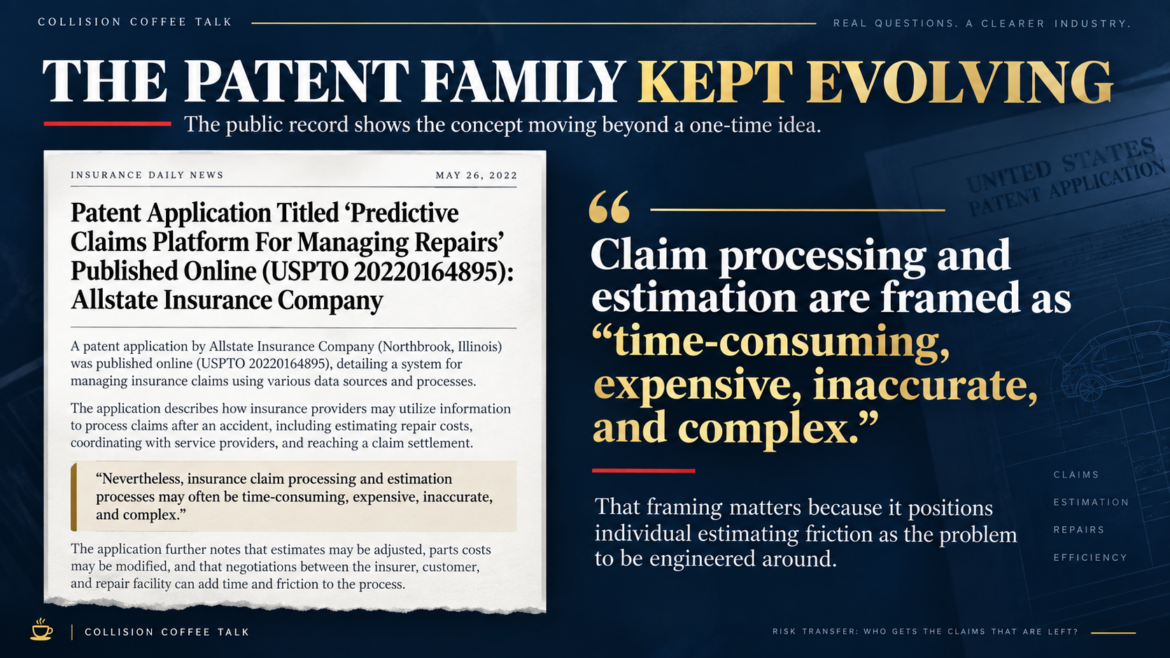
The patent family’s later language describes traditional claim processing and estimation as costly friction to be engineered around.
Now Look at the Explosion in Litigation
The history takes a current-events turn when viewed against the wave of litigation and regulatory disputes
involving claims-handling practices.
Cases and disputes in states including Oklahoma, Montana, Alabama, California, Illinois and Texas are
placing increased attention on insurer influence over claim decisions, repair-payment decisions, internal
standards, appraisal and the authority of the people handling losses.
Who makes the individual repair decision — and who carries the economic and legal risk associated with it?
Collision Repair Needs to Pay Attention to What Comes Next
The reason I believe this history matters now is that several economic pressures are converging at the same
time.
Insurers want more predictable repair economics. Large MSOs have unique financial pressures and need
utilization and claim volume. Vehicles are becoming more complicated to diagnose and repair. Individual
claim decisions are becoming more expensive to inspect, document, negotiate and supervise.
At the same time, litigation is placing greater scrutiny on how insurers influence those decisions, while the
overall pool of repairable claims is falling.
THE CONNECTION THAT MATTERS
The patent by itself is interesting. The Canadian history by itself is interesting. The litigation happening today is interesting. The shrinking repairable-claim pool is interesting.
The story is what happens when you put all of them together.
In the newest episode of Collision Coffee Talk, I walk through the documents, the history and the economics
behind where I believe this could be heading — and why the next great consolidation of collision repair may
have very little to do with one MSO buying another.
You need to hear this one.
Because the biggest disruption coming to collision repair may not be the next great estimating system.
It may be a claims model that no longer needs adjusters, traditional written shop estimates — or the
estimating software sitting between them.
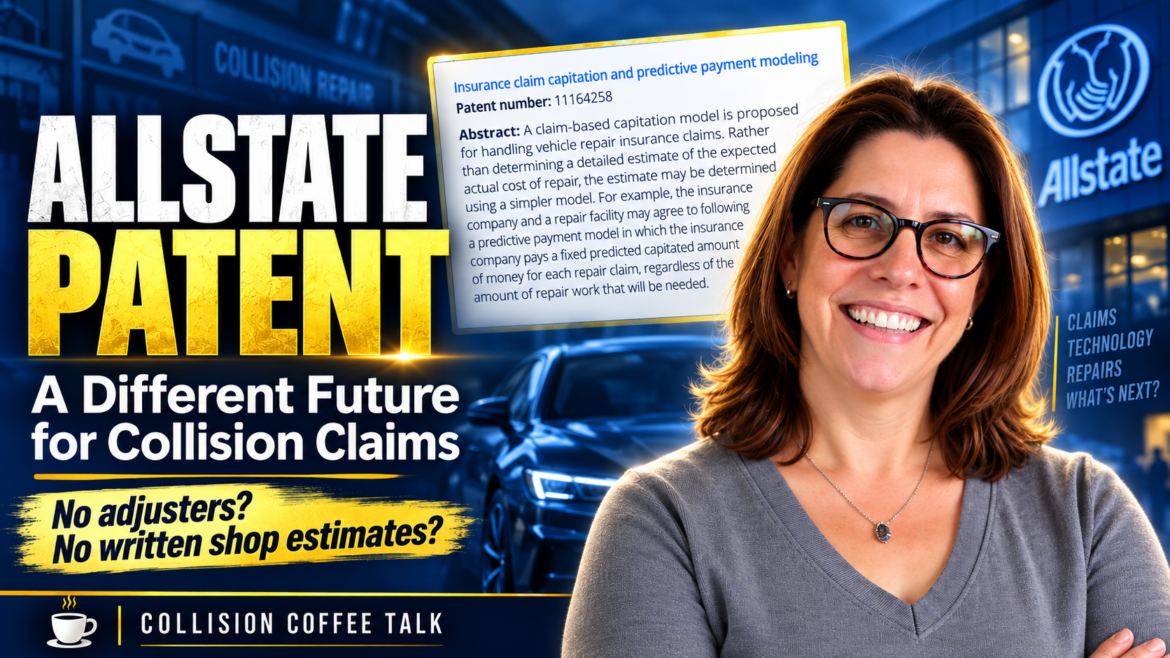
WATCH THE NEWEST EPISODE OF COLLISION COFFEE TALK
Follow the documents, the history and the economics behind a potentially different future for collision claims.