
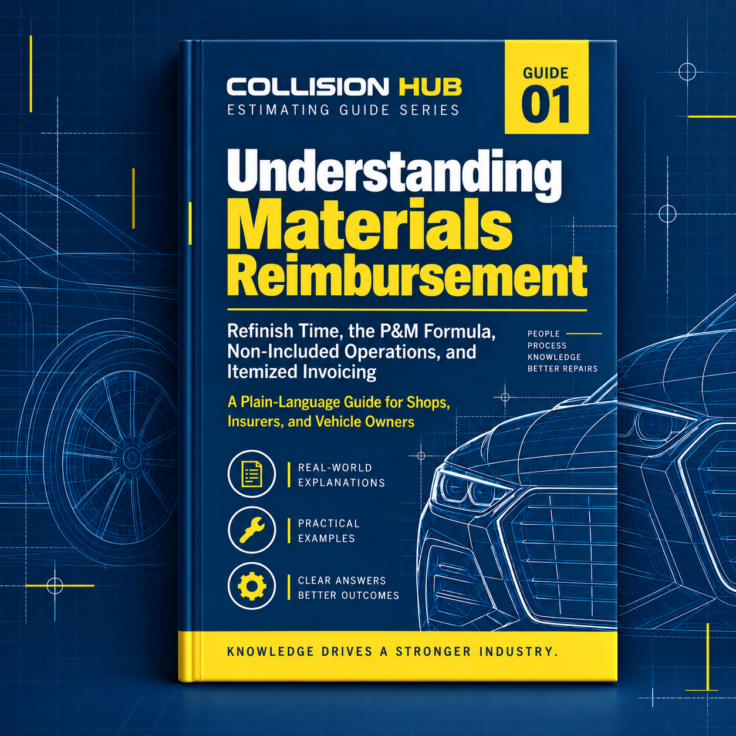
Estimating Guide Series · Guide 01
Understanding
Materials Reimbursement
A plain-language guide to where materials rates came from, how refinish hours are calculated, what the formulas leave out, and how repair-specific materials can be documented.
For shop professionals, insurers & vehicle owners
PRACTICAL KNOWLEDGE. STRONGER ESTIMATES. A MORE INFORMED INDUSTRY.
ABOUT THE GUIDE
Why can the same repair produce different materials totals?
One repair can be priced using a traditional paint-and-materials formula, a calculator, a mixing-system report, or a fully itemized invoice. Understanding Materials Reimbursement explains what each method measures and why the figures may differ.
Kristen Felder starts with the history of the materials rate, separates body materials from refinish materials, and explains how published refinish time is built. The guide then looks at work outside published assumptions, documents the limits of different accounting methods, and shows how to put a supported charge on an estimate.
Follow the calculation
See how panels, overlap deductions, and refinish hours affect a rate-based materials amount.
See what is missing
Distinguish fluid paint product from other refinish consumables and body-side materials.
Evaluate the record
Understand how a repair-specific invoice lists quantity, price, and the material consumed.
INSIDE GUIDE 01
Six questions the book helps answer.
The book develops these cover topics across 13 parts, from the history of the materials rate through invoicing, estimating, negotiation, and industry context.
01 / ORIGINS
Where did the materials rate come from?
02 / WHAT’S INCLUDED
What does a materials charge include?
03 / REFINISH TIME
How is refinish time applied?
04 / GUIDANCE
What do published assumptions and industry standards say?
05 / OPERATIONS
What are non-included operations?
06 / METHODS
What are four ways to account for materials?
INSIDE THE 13-PART GUIDE
From the materials rate to a repair-specific invoice.
The book’s sections build a foundation for understanding what is measured, what is charged, and why different approaches can produce different figures for the same vehicle.
01 / Parts 1–2
Where did the materials rate come from?
The guide traces the rate-based method as a market-level convention and asks what happens when product costs rise while the local rate does not. It then separates refinish materials—products that become or support the finish—from body and structural consumables such as abrasives, seam sealer, adhesives, and welding supplies. A calculation based on refinish hours does not automatically account for materials used on body operations.
The key distinction: a body material does not become a refinish material because both are used on the same repair.
02 / Parts 3–5
What published refinish time does—and assumes
The book explains the units of refinish time, major and minor components, and overlap deductions. It then examines the premise behind published time, including assumptions about continuous processes and panel-specific provisions. When a repair requires additional cycles or operations beyond those assumptions, both labor and associated material use need separate review.
Check the current estimating guide and the particular vehicle before treating a published time as complete.
03 / Parts 6–7
Why hours and materials can diverge
A rate multiplied by refinish hours can change even when the materials required by a particular repair do not change in the same proportion. The guide addresses additional refinish operations and non-included work, using environmental process control and equipment setup as examples. It asks readers to identify the exact task and its supporting material instead of relying on a broad miscellaneous charge.
The estimate should show what was done, why it was needed, and how the related charge was calculated.
04 / Part 8
Four methods for accounting for materials
Felder compares the rate-based multiplier, refinish materials calculators, pour-out and mixing-system documentation, and full itemized invoicing. A mixing report captures the fluid product poured for the vehicle; it does not by itself capture cup liners, masking supplies, abrasives, or body-side materials. A full invoice attempts to record consumables across both departments.
Before comparing two totals, establish which method and which categories each total includes.
05 / Parts 9–10
What an invoice documents—and how it reaches the estimate
A repair-specific invoice lists products, quantities, and prices, making the charge reviewable. The book illustrates refinish and body/structural sections of one repair order and explains how material systems and estimate line entries can present that information. It also cautions that moving to itemized billing requires reconciling or removing the allowance already produced by a P&M formula and any separate flat charges for the same products.
A product must not be charged once on an invoice and again through an overlapping formula or flat-dollar line.
06 / Parts 11–13
Consistency, objections, and the wider context
The closing parts consider whether itemization invites overcharging, how to identify the premise behind recurring objections, and why the shop’s billing method should be consistent across repairs. The guide encourages specific questions about an operation, item, quantity, price, or documentation. It also summarizes industry and regulatory context while warning readers to verify current guidance and law before relying on it.
The goal is a discussion about the facts of this repair and the method used to document it.
PART 8 · ACCOUNTING METHODS
What each materials figure measures.
The book compares four established ways to account for materials. Their totals should be read alongside their scope.
Method
What it measures
What to check
Rate-based multiplier
A paint-and-materials rate applied to refinish labor hours.
Which hours generated the amount, and which body-side materials fall outside it?
Refinish materials calculator
Preset values by panel and operation for refinish materials.
How well do the preset values reflect the products and repair involved?
Pour-out / mixing report
Fluid paint product mixed or poured for the repair order.
Which refinish consumables and body materials are absent from the report?
Full itemized invoice
Recorded consumables across refinish and body departments, with quantity and price.
Can the entries be checked against records, and have overlapping formula charges been reconciled?
Book note: First edition, September 2026. This educational guide discusses estimating methods and materials accounting. Its notice asks readers to check current estimating references and seek jurisdiction-specific advice before relying on legal or regulatory material.
A LOOK AT THE BOOK
Look beyond the formula.
The book shows why a refinish-hour multiplier, calculator, mixing report, and itemized invoice may produce different totals for one repair. It walks through published time assumptions, materials used in body and refinish operations, and the information needed to evaluate a particular charge.
- Trace refinish time from panel entries through overlap deductions.
- Compare what four accounting methods include and omit.
- Check itemized quantities and avoid overlapping charges.
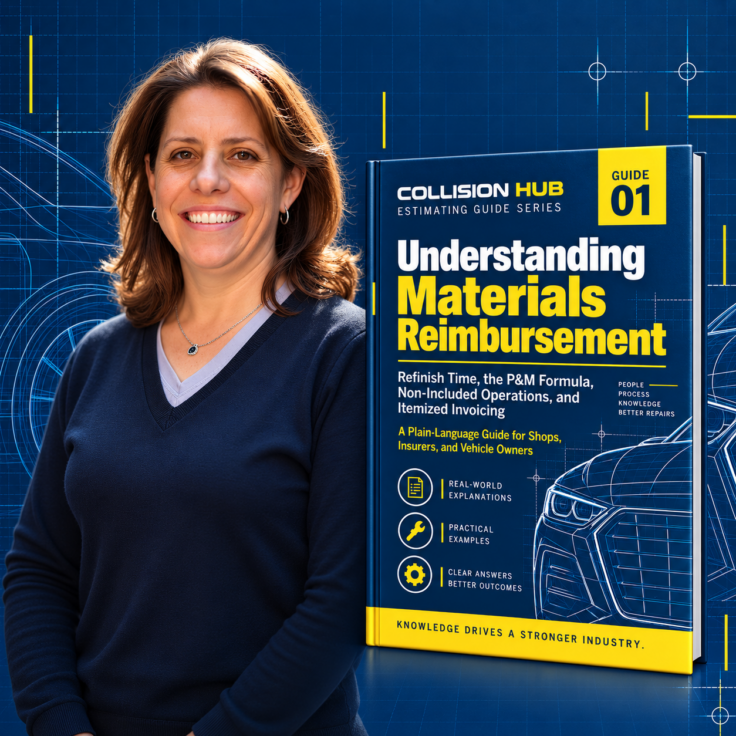
WHO THIS GUIDE IS FOR
Useful across the repair conversation.
Shop Professionals
Explain materials on estimates and build repair-specific documentation.
Insurers
Review the basis for a charge and identify questions that need a specific answer.
Vehicle Owners
Understand why materials appear on a collision repair estimate or invoice.
COMMON QUESTIONS
Materials reimbursement, explained.
It introduces the materials rate, included materials, refinish time, published assumptions, non-included operations, and ways to account for materials, as listed on the supplied back cover.
Yes. The front cover specifically identifies the P&M formula as one of the guide’s topics, alongside refinish time and itemized invoicing.
The book’s subtitle identifies shop professionals, insurers, and vehicle owners as its audiences.
The answer depends on the calculation and the repair. The book separates refinish and body materials and explains the published estimating assumptions. What a given formula covers should be checked against the current guidance and the repair being documented.
The book explains that an itemized invoice can list products consumed on a specific repair order, their quantities, and their prices. It also explains how to prevent the same materials from appearing twice in the total.