
The Behavioral Science of Subtraction
Why AI‑Generated Cost Estimates Should Begin with Comprehensive Outputs
Abstract
The underuse of AI estimating, review bots and procedure recommendation tools in collision repair estimating is often treated as a technological limitation. This article argues that it is more accurately understood as a behavioral design problem. Many existing systems identify omitted operations and require the estimator to actively add them to the repair plan. Although technically useful, this workflow places the burden of action on the user and may increase perceived workload, negotiation demands, and friction with insurers. Drawing on behavioral science concepts including omission bias, status quo bias, automation bias, and recognition-based decision processes, this article argues that additive estimating workflows are poorly aligned with predictable patterns of human decision-making. It proposes an alternative subtractive design model in which AI generates a comprehensive initial estimate and the estimator removes items deemed unsupported or unnecessary. This approach reframes the user’s role from initiating additions to editing and refining a proposed scope, a structure that may better support engagement, completeness, and consistent application of repair knowledge. The article presents a theory-informed framework for understanding how interface design influences estimator behavior and offers practical implications for the development of AI-assisted estimating systems in collision repair and related professional contexts.
Introduction
Artificial intelligence systems are increasingly being integrated into professional workflows that require users to evaluate technical conditions, define scopes of work, and generate cost estimates. In fields such as automotive collision repair, construction, insurance claims management, and equipment maintenance, AI-assisted tools can now produce preliminary estimates based on photographic damage analysis, historical repair data, and structured workflow inputs.
As these systems become more capable computationally, less attention has been given to the behavioral consequences of their design. In particular, the way an AI system structures user interaction may influence not only efficiency, but also the completeness and quality of the final estimate. A central design question therefore emerges: should an estimating system produce a limited initial output that requires the user to identify and add missing operations, or should it generate a broader preliminary estimate that the user refines by removing unsupported items?

This article argues that the distinction is not merely technical, but behavioral. Drawing on established findings in behavioral science, it proposes that additive workflows may place greater cognitive and motivational demands on users by requiring them to initiate actions associated with effort, uncertainty, and potential interpersonal friction. Subtractive workflows, by contrast, may better align with documented tendencies in human decision-making by positioning the user as a reviewer and editor rather than as the sole generator of missing content.
Rather than treating estimate completeness as a problem of information alone, this article presents a theory-informed framework for understanding it as a problem of interface design and decision structure. Using collision repair estimating as the primary applied context, it examines how omission bias, status quo bias, automation bias, and related decision mechanisms may help explain why AI systems that ask users to add may underperform relative to systems that ask users to remove.
Behavioral Foundations of Additive vs Subtractive Decision Making
Human decision-making is shaped by predictable cognitive tendencies that influence how individuals respond to defaults, omissions, and automated outputs. These tendencies are especially relevant in professional environments where users must review AI-generated recommendations and decide whether to expand, revise, or accept a proposed course of action. In estimating workflows, the structure of the task itself may influence whether users actively modify an initial output or passively leave it unchanged.
 One relevant mechanism is omission bias, which refers to the tendency to judge harmful actions more harshly than equally harmful inactions. Baron and Ritov (1994) demonstrated that individuals often prefer inaction over action when both options involve potential risk or negative consequences. In estimating environments, this tendency may discourage users from adding operations that could later be challenged, questioned, or require further justification. Even when the omission of a legitimate line item produces an inferior estimate, the act of adding it may feel more exposed and consequential than simply leaving the original output unchanged.
A related mechanism is status quo bias, or the tendency to prefer existing conditions and default options over change. Samuelson and Zeckhauser (1988) found that individuals disproportionately favor preexisting states, even when alternatives may be more appropriate. In AI-assisted estimating systems, the initial estimate generated by the software may function as a default baseline. Once presented in that form, it can acquire psychological weight beyond its technical status as a draft. Users may become less likely to modify it, not because it is complete, but because deviation requires additional effort, attention, and justification.
Automation bias further reinforces this pattern. Parasuraman and Riley (1997) describe automation bias as the tendency for users to place excessive trust in automated systems and to rely on them even when their outputs are incomplete or flawed. In the context of estimating, this may lead users to assume that an AI-generated estimate has already accounted for all relevant operations, reducing the likelihood that they will critically evaluate omissions. When combined with omission bias and status quo bias, automation bias helps explain why additive estimating workflows may underperform: they require users not only to notice what is missing, but also to overcome the psychological pull of inaction, default acceptance, and trust in the system’s apparent completeness.
Recognition vs. Recall in Cognitive Processing
Another important factor affecting estimate completeness is the distinction between recognition-based and recall-based cognitive processing. Constructing an estimate from scratch depends heavily on recall, requiring the user to retrieve from memory the full range of operations, procedures, and line items that may apply to a particular repair or job scope. This places substantial cognitive demands on the estimator and increases the likelihood that relevant items will be overlooked.
By contrast, reviewing a structured list of potential operations relies more heavily on recognition. In this form of processing, the user is not required to generate missing items independently, but instead to evaluate whether presented items are applicable. Research in cognitive psychology has long distinguished recognition from recall and generally finds recognition tasks to be less cognitively demanding than tasks requiring unaided retrieval.
Subtractive estimating workflows are significant in this respect because they shift the user’s task from generation to evaluation. Rather than relying primarily on memory to identify what should be added, the estimator reviews a broader proposed scope and determines what should remain, be removed, or be revised. This structure may reduce cognitive load, improve user engagement with the estimate, and decrease the risk that legitimate operations will be omitted through passive non-generation.
Subtractive Thinking in Human Problem Solving
Recent research offers additional insight into how additive and subtractive thinking differ in problem-solving contexts. Adams et al. (2021) found that individuals often fail to consider subtractive solutions, even when those solutions are simpler and more effective than additive alternatives. Importantly, however, the study also found that subtractive responses became substantially more common when participants were explicitly prompted to think in terms of removal rather than addition.

This finding is relevant to estimating workflows because it suggests that subtractive reasoning is not always spontaneously activated, but can be meaningfully increased through task design. In an estimating environment, presenting a comprehensive list of potential operations effectively creates such a prompt. Rather than requiring the user to generate missing items independently, the system asks the user to review an existing scope and determine what should remain, be removed, or be revised. This shifts the task toward structured evaluation and reduces exclusive reliance on unaided recall.
This type of workflow also resembles established review practices in fields such as auditing and quality control, where professionals are often more effective when evaluating, correcting, or narrowing an existing body of work than when constructing a complete analysis from a blank starting point. In that sense, subtractive estimating models may improve estimate completeness not because users naturally think subtractively on their own, but because the interface deliberately organizes the task in a way that elicits subtractive review.
Operational Implications in Estimating Environments
The design of AI estimating systems may have important operational and financial consequences. When an estimate begins with a narrow or incomplete scope of work, the user must actively recognize, justify, and add omitted operations. Because this process depends on user initiative under conditions shaped by omission bias, automation bias, and cognitive load, legitimate repair-related items may remain absent from the final estimate.
In collision repair settings, such omissions may involve diagnostic procedures, corrosion protection steps, seam sealing, specialized repair operations, or required calibration processes. These are not incidental details, but potentially compensable components of the repair process that may affect both estimate completeness and the economic accuracy of the repair plan.
When omissions of this kind occur repeatedly across large numbers of estimates, the cumulative effect may be substantial. Organizations relying on additive AI workflows may therefore face a recurring risk of under-inclusion, not necessarily because the relevant operations are unknown, but because the structure of the workflow makes their inclusion less likely. In this sense, estimate incompleteness may reflect a behavioral design problem as much as a technical one.
Design Implications for AI Estimating Systems
The behavioral considerations discussed above suggest several principles for the design of AI estimating systems. First, systems may be more effective when they begin with a broad preliminary output that includes the full range of potentially applicable operations relevant to the repair or task. This approach reduces reliance on user recall and creates a more complete baseline for review.
Second, user interaction may be better structured around subtraction than addition. Rather than requiring users to identify and enter omitted operations independently, systems may support more consistent decision-making by asking users to remove, revise, or confirm items within an already developed estimate. This shifts the task from generation to evaluation and may better align with documented patterns in human cognition.
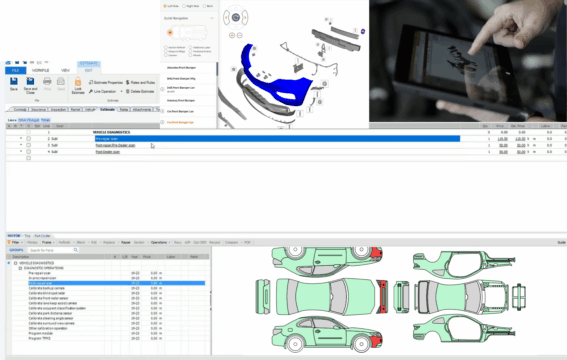
Third, structured review prompts may improve engagement with the estimating process. Checkpoints organized around major operational categories, such as diagnostics, protection procedures, calibration requirements, or repair-specific processes, may help direct user attention to areas where omissions are likely to occur.
Fourth, transparency in system logic remains important. Providing users with a brief explanation for why specific operations were included may reduce overreliance on automated output and encourage more deliberate review. In this sense, transparency serves not only an informational function, but also a behavioral one by helping the user remain actively engaged with the estimate rather than passively accepting it.
Taken together, these design principles suggest that AI estimating systems may be more effective when they are built to accommodate predictable features of human decision-making rather than assuming purely rational or fully effortful user behavior. Such systems may be better positioned to support estimate completeness, consistency, and informed professional judgment.
Limitations and Need for Empirical Validation
This article advances a theory-informed framework for AI estimating design based on established findings in behavioral science. It does not report original experimental findings from collision repair or other estimating environments. Future research should test additive and subtractive workflow designs directly, including their effects on estimate completeness, user confidence, negotiation behavior, and financial outcomes. Such research would help determine the extent to which these behavioral principles translate into measurable operational improvements.
Conclusion
The integration of artificial intelligence into professional estimating workflows presents both meaningful opportunities and important design challenges. While AI systems can accelerate estimate generation and support technical decision-making, the structure of user interaction remains critical to the quality and completeness of the final output.
This article has argued that the performance of AI estimating systems should not be understood solely as a matter of computational capability, but also as a matter of behavioral design. Drawing on established findings in behavioral science, it has proposed that additive workflows may be less effective because they require users to initiate effortful actions under conditions shaped by omission bias, status quo bias, automation bias, and the cognitive demands of recall-based processing.
By contrast, subtractive workflows may offer a more effective design model by shifting the user’s role from generation to evaluation. When AI systems produce broader initial estimates that users refine through review, removal, and confirmation, they may better support estimate completeness and more consistent engagement with relevant operations.
For organizations implementing AI-assisted estimating tools, the implication is clear: workflow design matters. Systems that are structured around predictable features of human decision-making may be better positioned to support informed professional judgment, reduce passive under-inclusion, and improve operational consistency. More broadly, this perspective suggests that the future effectiveness of AI in estimating environments will depend not only on what the technology can generate, but on how well its design fits the way people actually decide.
Keywords
Artificial intelligence, behavioral economics, omission bias, automation bias, status quo bias, collision repair estimating, decision psychology
References
Adams, G. S., Converse, B. A., Hales, A. H., & Klotz, L. E. (2021). People systematically overlook subtractive changes. Nature, 592(7853), 258–261. https://doi.org/10.1038/s41586-021-03380-y
Baron, J., & Ritov, I. (1994). Reference points and omission bias. Organizational Behavior and Human Decision Processes, 59(3), 475–498. https://doi.org/10.1006/obhd.1994.1070
Haist, F., Shimamura, A. P., & Squire, L. R. (1992). On the relationship between recall and recognition memory. Journal of Experimental Psychology: Learning, Memory, and Cognition, 18(4), 691–702. https://doi.org/10.1037/0278-7393.18.4.691
Iyengar, S. S., & Lepper, M. R. (2000). When choice is demotivating: Can one desire too much of a good thing? Journal of Personality and Social Psychology, 79(6), 995–1006. https://doi.org/10.1037/0022-3514.79.6.995
Johnson, E. J., & Goldstein, D. (2003). Do defaults save lives? Science, 302(5649), 1338–1339. https://doi.org/10.1126/science.1091721
Mandler, G. (1980). Recognizing: The judgment of previous occurrence. Psychological Review, 87(3), 252–271.
Parasuraman, R., & Riley, V. (1997). Humans and automation: Use, misuse, disuse, abuse. Human Factors, 39(2), 230–253. https://doi.org/10.1518/001872097778543886
Samuelson, W., & Zeckhauser, R. (1988). Status quo bias in decision making. Journal of Risk and Uncertainty, 1(1), 7–59. https://doi.org/10.1007/BF00055564
Sweller, J. (1988). Cognitive load during problem solving: Effects on learning. Cognitive Science, 12(2), 257–285. https://doi.org/10.1207/s15516709cog1202_4