
What Independent Shop Owners Can Learn About Power, Pressure, and Survival
Five Lessons in Leadership from Al Capone
Leadership is not always learned from perfect people. Sometimes the clearest lessons come from flawed, controversial, and complicated figures whose rise and fall reveal how power works, how loyalty is built, how fear spreads, how organizations survive, and how empires collapse when leadership becomes too dependent on control.
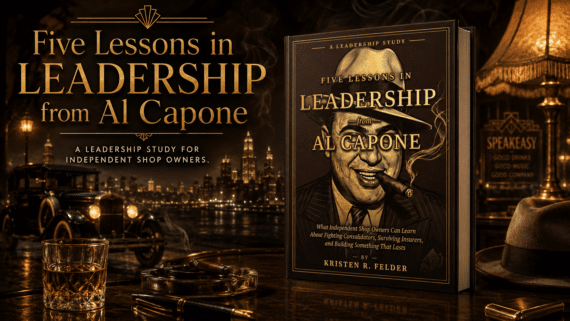
Five Lessons in Leadership from Al Capone by Kristen R. Felder uses the story of one of America’s most infamous Prohibition-era figures as a framework for modern business leadership, especially for independent collision repair shop owners facing consolidation, insurer pressure, changing customer behavior, and a rapidly shifting industry.
This is not a book that glorifies crime or celebrates Al Capone. It is a leadership study that looks at how influence, reputation, loyalty, fear, strategy, and organizational weakness can shape the future of a business. For collision repair professionals, the book uses history as a mirror: the past may look different, but the pressure to survive powerful systems is familiar.

Why Study Leadership Through Al Capone?
Al Capone remains one of the most recognized figures from the Prohibition era because his story sits at the intersection of business, power, politics, public image, fear, loyalty, and collapse. He operated in a world where formal systems were weak, informal power was strong, and survival depended on knowing who controlled the money, the streets, the message, and the relationships.
Modern business leaders are not operating in Capone’s world, but many of the leadership questions are still recognizable.
Who has power?
Who controls access?
Who decides the rules?
Who benefits from fear?
Who survives consolidation?
Who builds loyalty that lasts?
Who confuses control with leadership?
For independent shop owners, these questions matter. Collision repair has become a more consolidated, insurer-influenced, process-driven industry. Shops face pressure from large multi-shop operators, referral networks, direct repair programs, labor shortages, rising costs, customer confusion, and changing claims practices.
Five Lessons in Leadership from Al Capone uses history to help business owners think more clearly about power before they are trapped by it.
A Leadership Book for Independent Collision Repair Shop Owners
Independent collision repair shop owners operate in a difficult environment. They must serve customers, negotiate with insurers, retain employees, manage vendors, invest in equipment, follow repair procedures, protect safety, and stay profitable while competing against larger organizations with more capital and more influence.
This book speaks directly to that reality.
It is written for leaders who understand that survival is not only about working harder. It is also about understanding systems, incentives, alliances, pressure, and reputation. A shop can have talent and still lose ground if it does not understand the power structure around it.
The book asks independent shop owners to consider:
- What makes people follow a leader?
- What happens when fear replaces trust?
- How does a business protect its independence?
- When does loyalty become a strength, and when does it become a liability?
- How do powerful organizations influence smaller businesses?
- What causes leaders to lose perspective?
- How can a shop build something that lasts beyond one person?
These are not abstract questions. They are practical leadership questions for shops trying to survive in a changing industry.
Lesson One: Power Must Be Understood Before It Can Be Challenged
One of the central ideas in the book is that power is rarely neutral. Power shapes decisions, behavior, opportunity, and survival. Al Capone understood power better than many of the institutions that tried to stop him, and that understanding helped him rise quickly.
For shop owners, the lesson is not to imitate Capone. The lesson is to understand the environment before fighting it.
In collision repair, power can come from many places: insurer referral programs, customer trust, OEM certifications, local reputation, technician skill, legal knowledge, repair quality, data access, business discipline, and financial resilience. A shop that does not know where power sits may spend years fighting the wrong battle.
Five Lessons in Leadership from Al Capone encourages leaders to identify the real forces affecting their business instead of reacting only to the pressure they feel each day.
Lesson Two: Reputation Is a Business Asset
Capone’s public image was carefully shaped. He understood that reputation could create fear, loyalty, fascination, and protection. His image became part of his power.
For legitimate business leaders, reputation must be built on trust, service, quality, consistency, and credibility. In collision repair, a shop’s reputation can determine whether customers listen, whether employees stay, whether insurers take the shop seriously, and whether the community sees the business as a trusted advocate or just another vendor.
Independent shops often underestimate the value of reputation because they are busy doing the work. But in a crowded and competitive market, reputation becomes leverage.
A shop known for documentation, quality repairs, professional communication, customer education, and ethical leadership has a stronger foundation than a shop that relies only on technical skill or owner personality.

Lesson Three: Loyalty Cannot Be Bought Forever
Capone built loyalty through money, protection, favors, fear, and personal connection. But loyalty built on dependence and fear has limits. When pressure increases, people begin making decisions based on self-preservation.
That is an important leadership lesson.
In a collision repair business, loyalty cannot depend only on personality, crisis management, or “family” language. Employees need structure, opportunity, fairness, training, and a reason to believe the business has a future. Customers need transparency and confidence. Vendors and partners need consistency.
A shop owner who wants loyalty must build a business worth being loyal to.

Five Lessons in Leadership from Al Capone challenges leaders to think about whether their people are loyal to the mission, loyal to the paycheck, loyal to the owner, or simply afraid to leave. Those are very different forms of loyalty, and only some of them create long-term strength.
Lesson Four: Control Is Not the Same as Leadership
Capone controlled people, territory, money, and information. Control helped him rise, but it also made the organization fragile. When a business depends too heavily on one person’s control, it becomes vulnerable when that person is distracted, removed, wrong, or overwhelmed.
Many small businesses face a version of this problem.
A collision repair shop may be built around one strong owner, one master estimator, one production manager, or one key technician. That strength can become a weakness if the business cannot function without that person. Leadership is not just getting people to follow orders. Leadership is building a system that can continue working when pressure increases.
The book encourages shop owners to move from control to structure:
- Document the process.
- Train the team.
- Share knowledge.
- Build accountability.
- Create repeatable standards.
- Make decisions based on principles, not panic.
- Build a business that does not collapse when one person steps away.
A lasting business needs leadership that can be transferred, not just authority that can be enforced.
Lesson Five: Survival Requires Adaptation
Capone rose during a specific historical moment. Prohibition created opportunity, confusion, corruption, unmet demand, and a market where illegal operators could grow quickly. But when the environment changed, the foundation of that power became unstable.
Every industry has moments when the rules change.
Collision repair is experiencing its own version of that shift. Consolidation, insurer influence, OEM repair requirements, advanced vehicle technology, ADAS, calibration, rising repair costs, total loss frequency, labor shortages, and customer expectations are changing what it takes to survive.
The shops that last will not be the ones that simply complain about change. They will be the ones that understand it, adapt to it, and build stronger systems because of it.

Five Lessons in Leadership from Al Capone uses history to remind shop owners that no empire lasts on momentum alone. Survival requires awareness, discipline, adaptation, and the humility to change before the market forces the change.
What Collision Repair Leaders Can Learn From History
History is useful because it gives business leaders distance. When we study the past, we can see patterns more clearly than we can see them in our own businesses.
The story of Al Capone reveals patterns that still matter today:
- Power grows where systems are weak.
- Reputation can be both an asset and a trap.
- Loyalty must be built on more than fear or favors.
- Control can create short-term strength and long-term fragility.
- Public image can shape business outcomes.
- Organizations fail when leadership loses discipline.
- A business built only around one dominant personality is vulnerable.
- Survival depends on adapting before the environment changes completely.
For collision repair shop owners, these lessons apply to insurer relationships, employee retention, customer communication, market consolidation, business planning, and leadership development.
The book does not ask readers to admire Capone. It asks them to study the warning signs.
Who Should Read Five Lessons in Leadership from Al Capone?
This book is written for leaders, business owners, and collision repair professionals who want a different kind of leadership study.
It is especially relevant for:
- Independent collision repair shop owners
- General managers
- Estimators and repair planners moving into leadership
- Industry consultants and trainers
- Collision repair executives
- Family-owned shop operators
- Business owners facing consolidation pressure
- Leaders trying to build stronger teams
- Professionals interested in business history
- Readers who enjoy leadership lessons from historical figures
The book is designed to be practical, memorable, and different from a traditional leadership manual. It uses a historical story to create a sharper conversation about modern business survival.
What Readers Will Learn
Readers will learn how to think more critically about:
- Power structures inside an industry
- Reputation as a leadership asset
- The difference between loyalty and dependence
- Why control can weaken a business
- How organizations become fragile
- Why independent shops must build systems, not just personalities
- How consolidation changes leadership pressure
- Why survival requires adaptation
- How historical patterns can help business owners make better decisions
The book gives collision repair leaders a framework for looking beyond daily problems and seeing the larger forces shaping their businesses.
A Different Kind of Leadership Book
Many leadership books focus only on inspiration, motivation, or success stories. Five Lessons in Leadership from Al Capone takes a different approach. It studies leadership through a flawed and dangerous historical figure because failure, corruption, power, and collapse often teach lessons that polished success stories avoid.
For independent shop owners, that makes the book especially useful.
Collision repair is not an easy industry. It is full of pressure, negotiation, competition, insurer influence, customer confusion, and operational risk. Leaders need more than slogans. They need sharper thinking, stronger systems, and a better understanding of power.
This book gives readers a historical framework for asking better questions about the future of their business.
If you are an independent shop owner, collision repair leader, or business professional trying to understand how power, loyalty, reputation, control, and survival shape leadership, this book was written for you.
Five Lessons in Leadership from Al Capone is a leadership study for people building businesses in hard environments. It uses history to help modern leaders think more clearly, lead more strategically, and build something that lasts.